Finding the best learning apps for elementary students — or as parents often search, the best study app for kids — can be overwhelming. With thousands of options on the App Store and Google Play, how do you choose one that actually helps your child learn, and keeps them engaged for more than a week?
This is the honest 2026 verdict on the best learning apps for elementary students. We compared five of the most popular study and learning apps for children ages 4–12 across the criteria that actually matter: subject coverage, adaptive difficulty, language support, safety and privacy, and whether teachers can use them in real classrooms. We sat with kids and watched what they actually did.
What We Looked For
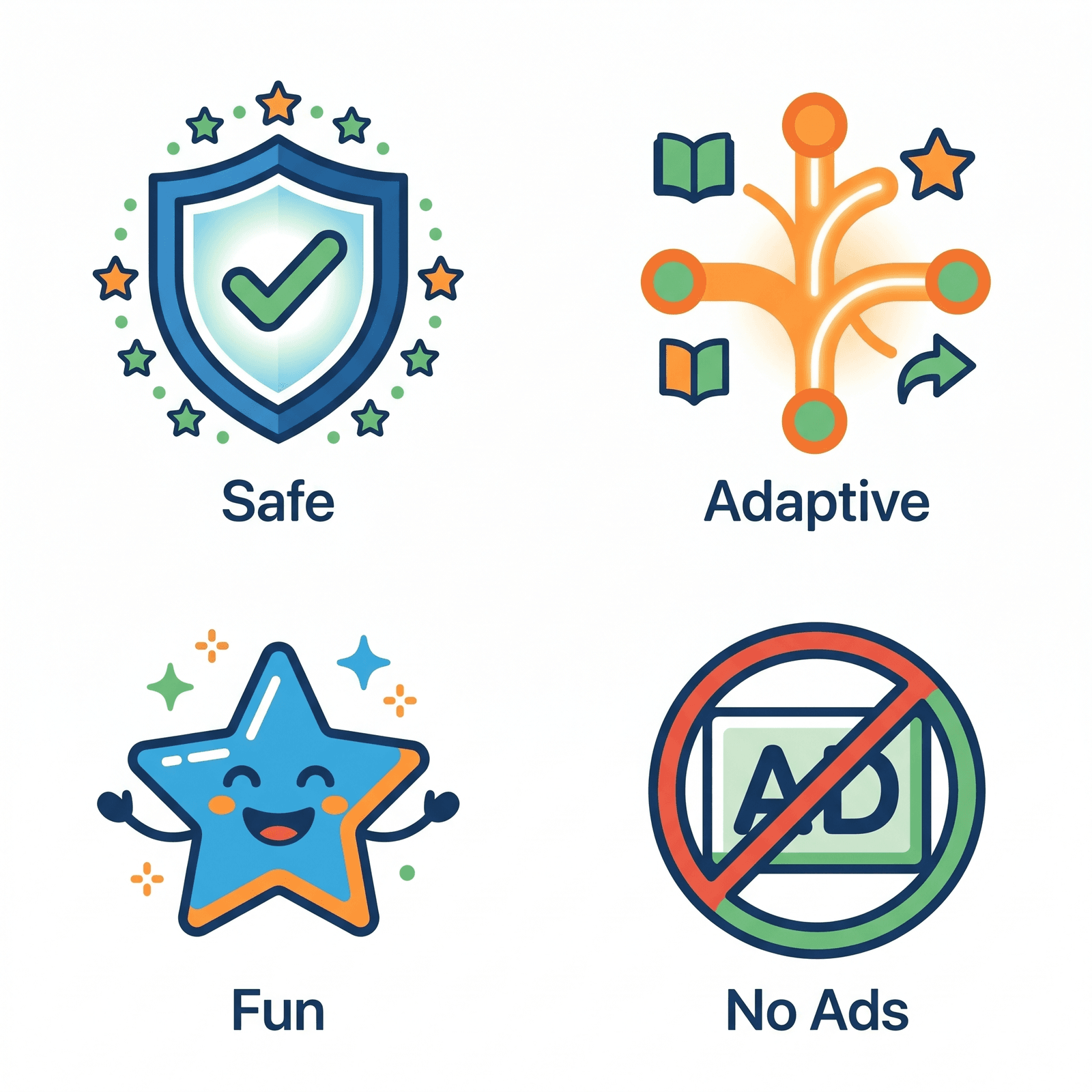
- Multi-subject coverage — Does the app go beyond one subject?
- Adaptive difficulty — Does it adjust to each child's level?
- Language support — Can children learn in their native language?
- Privacy & safety — No ads, no data collection, COPPA compliant?
- School integration — Can teachers use it in classrooms?
1. Samio Learning
Best for: Multi-subject practice across reading, math, writing, and time-telling
What sets Samio apart is its adaptive difficulty engine that adjusts to each child's performance in real time, a daily goal system with achievement badges to keep kids motivated, and a companion Samio for Schools platform that gives teachers real-time analytics, custom challenges, and class management tools.
Samio is ad-free, collects no personal data from children, and is fully COPPA compliant — making it safe for both home and classroom use.
- Subjects: Reading, writing, math, grammar, clock reading, letter tracing
- Ages: 4–12
- Languages: 7 (EN, ES, NL, DE, FR, IT, PT)
- School tools: Yes — Samio for Schools dashboard
- Ads: None
- Privacy: COPPA compliant, no personal data collected
2. Khan Academy Kids
Best for: Free, broad early-learning curriculum
Khan Academy Kids is a completely free app aimed at children ages 2–8. It covers reading, math, social-emotional development, and creative activities. The curriculum is well-structured and aligned with Head Start and Common Core standards.
It's an excellent choice for younger children who are just beginning their learning journey. However, it has limited content for children older than 8, and its language support is primarily English.
- Subjects: Reading, math, social-emotional learning, creative arts
- Ages: 2–8
- Languages: Primarily English
- School tools: Teacher resources available
- Ads: None
- Price: Free
3. Duolingo
Best for: Language learning for older kids and teens
Duolingo is the world's most popular language-learning app. Its gamified approach — with streaks, XP points, and leaderboards — keeps learners engaged. It supports over 40 languages and has a dedicated kids mode.
Duolingo focuses exclusively on language learning, so it won't help with math or other subjects. It's best suited for children who already have foundational reading skills (roughly ages 7+). Duolingo for Schools provides teacher dashboards.
- Subjects: Language learning only
- Ages: 7+ (younger with parental help)
- Languages: 40+
- School tools: Duolingo for Schools
- Ads: Yes (free tier), none with Duolingo Plus
- Price: Free with premium option
4. Lingokids
Best for: English language immersion for younger children
Lingokids is designed for children ages 2–8 and focuses on English learning through games, songs, and interactive activities. It's popular with non-English-speaking families who want to introduce English early.
The app covers vocabulary, phonics, and basic math, with content created in partnership with Oxford University Press. It's well-designed for its target age group but doesn't extend to older elementary-age children.
- Subjects: English language, basic math, vocabulary
- Ages: 2–8
- Languages: English-focused, interface in multiple languages
- School tools: Limited
- Ads: None
- Price: Subscription required
5. ELSA Speak
Best for: English pronunciation and speaking practice
ELSA Speak uses AI-powered speech recognition to help learners improve their English pronunciation. It provides detailed feedback on individual sounds, stress patterns, and intonation.
While it's excellent for pronunciation training, it's primarily designed for adult and teenage learners. Younger children may find the interface less engaging. It focuses exclusively on English speaking skills.
- Subjects: English pronunciation and speaking
- Ages: 13+ (best fit)
- Languages: English pronunciation only
- School tools: ELSA for Schools
- Ads: Limited
- Price: Free with premium option
Comparison Summary
| Feature | Samio | Khan Academy Kids | Duolingo | Lingokids | ELSA Speak |
|---|---|---|---|---|---|
| Reading & Phonics | ✅ | ✅ | — | ✅ | — |
| Math | ✅ | ✅ | — | Basic | — |
| Writing & Grammar | ✅ | — | ✅ | — | — |
| Clock / Time | ✅ | — | — | — | — |
| Ages 4–12 | ✅ | 2–8 | 7+ | 2–8 | 13+ |
| Multi-language | 7 | 1 | 40+ | 1 | 1 |
| Adaptive difficulty | ✅ | ✅ | ✅ | — | ✅ |
| School dashboard | ✅ | Basic | ✅ | — | ✅ |
| Ad-free | ✅ | ✅ | Paid | ✅ | Paid |
| COPPA compliant | ✅ | ✅ | ✅ | ✅ | — |
Which App Is Right for Your Child?
- If you want one app that covers everything — reading, math, writing, grammar, and time-telling with adaptive difficulty in multiple languages — Samio Learning is the most comprehensive option for ages 4–12.
- If your child is under 6 and you want something free — Khan Academy Kids offers excellent early-learning content at no cost.
- If your focus is specifically language learning — Duolingo is the clear leader for older children who want to learn a new language.
- If you want English immersion for toddlers — Lingokids provides a rich English environment for the youngest learners.
- If pronunciation is the priority — ELSA Speak is the best choice for teens and adults working on English pronunciation.
For Schools and Educators
If you're a teacher or school administrator looking to integrate a learning app into your classroom, Samio for Schools offers real-time student analytics, custom challenges, class group management, a yearly curriculum planner, and device management — all in a COPPA-compliant environment that collects no personal student data.
See our detailed comparison of learning apps for classrooms →