Interactive practice tools for children ages 4–12
Math anxiety is real — and it often starts in elementary school. Picking the best math app for kids matters: the right one builds confidence through consistent, low-pressure practice at a child's own pace, while the wrong one drills the same skill until kids quit. Interactive math apps make daily practice possible with immediate feedback, adaptive difficulty, and engaging exercises.
This is a parent's guide to the best math apps for kids in 2026 — including free math apps for kids, paid subscriptions, and school-grade platforms. Here's what to look for, and how the top options compare for ages 4–12.
Why Math Apps Work
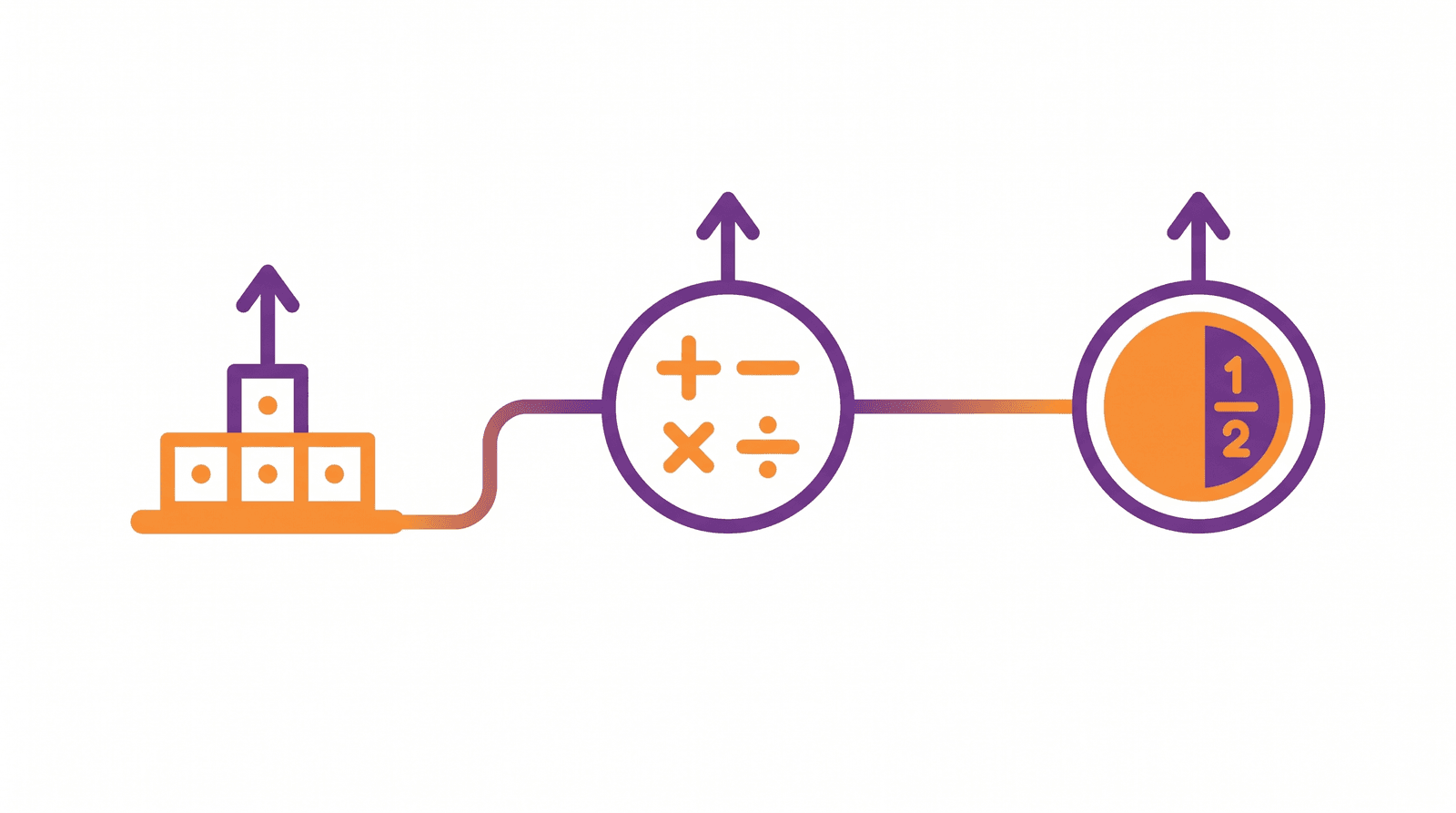
The biggest advantage of app-based math practice is adaptive difficulty. Instead of giving every child the same worksheet, an adaptive app adjusts — offering easier problems when a child is struggling and harder ones when they're ready. This keeps kids in their "zone of proximal development" where learning is most effective.
Research published in the Journal of Educational Psychology suggests that students who use adaptive math tools for 15 minutes daily show measurably improved fluency within 4–6 weeks compared to traditional practice alone.
What a Good Math App Should Cover
For elementary-age children (ages 4–12), a comprehensive math app should include:
- Number sense — counting, number recognition, place value
- Operations — addition, subtraction, multiplication, division
- Fractions & decimals — visual models, equivalence, basic operations
- Measurement — length, weight, volume, unit conversions
- Time — reading clocks (analog and digital), elapsed time
- Problem solving — word problems, multi-step reasoning
Top Math Apps Compared
Samio Learning
Samio's math exercises use adaptive difficulty that adjusts in real time, with visual explanations available when a child gets stuck. Progress is tracked across topics, and the daily goal system encourages consistent practice.
For schools, Samio for Schools provides teacher analytics showing exactly where each student is in the math curriculum, which operations they find difficult, and how their accuracy is trending over time.
- Math topics: Operations, fractions, decimals, unit conversions, clock reading
- Also covers: Reading, writing, grammar (multi-subject)
- Ages: 4–12
- Languages: 7
- Adaptive: Yes
- Ad-free: Yes
Khan Academy Kids
Khan Academy Kids offers math content for younger children (ages 2–8), focusing on counting, shapes, basic addition and subtraction, and early number sense. It's completely free and has no ads, making it an excellent starting point for preschool and early elementary math.
However, it doesn't extend into more advanced elementary topics like fractions, unit conversions, or multi-digit operations.
Prodigy Math
Prodigy Math uses an RPG-style game format where students solve math problems to progress through a fantasy world. It's popular with kids who enjoy gaming. The math content is curriculum-aligned and adaptive.
The free version has some distracting game elements, and full features require a paid membership. Some educators note that students sometimes focus more on the game than the math.
Mathletics
Mathletics is a school-focused math platform used in many English-speaking countries. It offers structured curriculum-aligned content and teacher tools. It's more traditional in approach — closer to digital worksheets than game-based learning.
It's comprehensive for schools but requires a school subscription, making it less accessible for home use.
Comparison at a Glance
| Feature | Samio | Khan Academy Kids | Prodigy Math | Mathletics |
|---|---|---|---|---|
| Age range | 4–12 | 2–8 | 6–14 | 5–14 |
| Basic operations | ✅ | ✅ | ✅ | ✅ |
| Fractions & decimals | ✅ | — | ✅ | ✅ |
| Unit conversions | ✅ | — | — | ✅ |
| Clock / time | ✅ | — | — | Basic |
| Adaptive difficulty | ✅ | ✅ | ✅ | ✅ |
| Multi-subject | ✅ | ✅ | — | — |
| Teacher dashboard | ✅ | Basic | ✅ | ✅ |
| Ad-free | ✅ | ✅ | Paid | ✅ |
| Languages | 7 | 1 | 3 | 1 |
| COPPA compliant | ✅ | ✅ | ✅ | ✅ |
Tips for Parents
- Consistency matters more than duration — 10–15 minutes of daily math practice is more effective than longer, irregular sessions.
- Look for adaptive difficulty — one-size-fits-all apps can frustrate or bore your child.
- Check the full curriculum — an app that only covers basic addition won't grow with your child. Look for one that covers operations through fractions, decimals, and measurement.
- Avoid apps with heavy gamification — some game-based apps distract from the actual math. Look for a balance of engagement and learning.
Tips for Teachers
When choosing a math app for classroom use, prioritize:
- Teacher analytics that show per-student progress
- Curriculum alignment so the app reinforces your teaching
- The ability to assign specific topics or create custom challenges
- COPPA compliance and student data privacy
Samio for Schools Samio for Schools offers all of these — from $4.99/month for a homeschool group of up to 10 students, or $19/month for a class of up to 60 — with a 14-day free trial.