
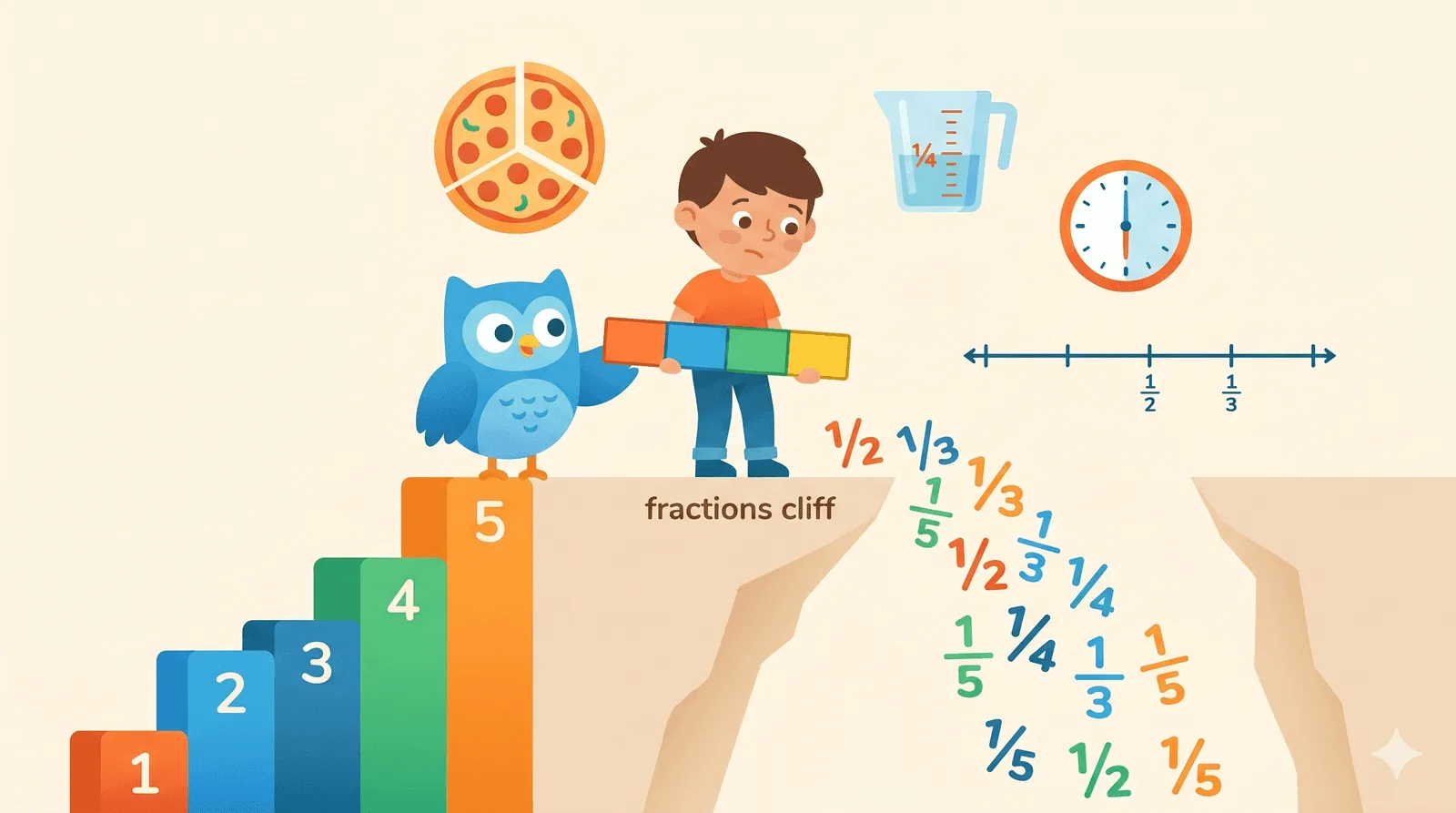
Fractions are the cliff most kids fall off in primary math. A child who happily adds, subtracts, multiplies and divides whole numbers can suddenly freeze when ½ + ⅓ shows up. Parents and teachers see it constantly — and most assume it's a practice problem. It usually isn't.
The truth is that fractions break a lot of intuitions kids spent years building. The fix isn't more drilling. It's targeted re-teaching that meets kids where the intuition broke.
The 4 reasons kids struggle with fractions
1. Fractions invert what kids learned about "bigger"
For years, every math instinct says: more is bigger. Five is bigger than three. Then fractions arrive and 1/5 is smaller than 1/3, even though 5 is bigger than 3. The denominator is doing the opposite of what kids' arithmetic intuition trained them to expect. Until that flip is named explicitly, kids guess wrong — confidently — and then doubt themselves the next time.
2. They need visual AND symbolic intuition at the same time
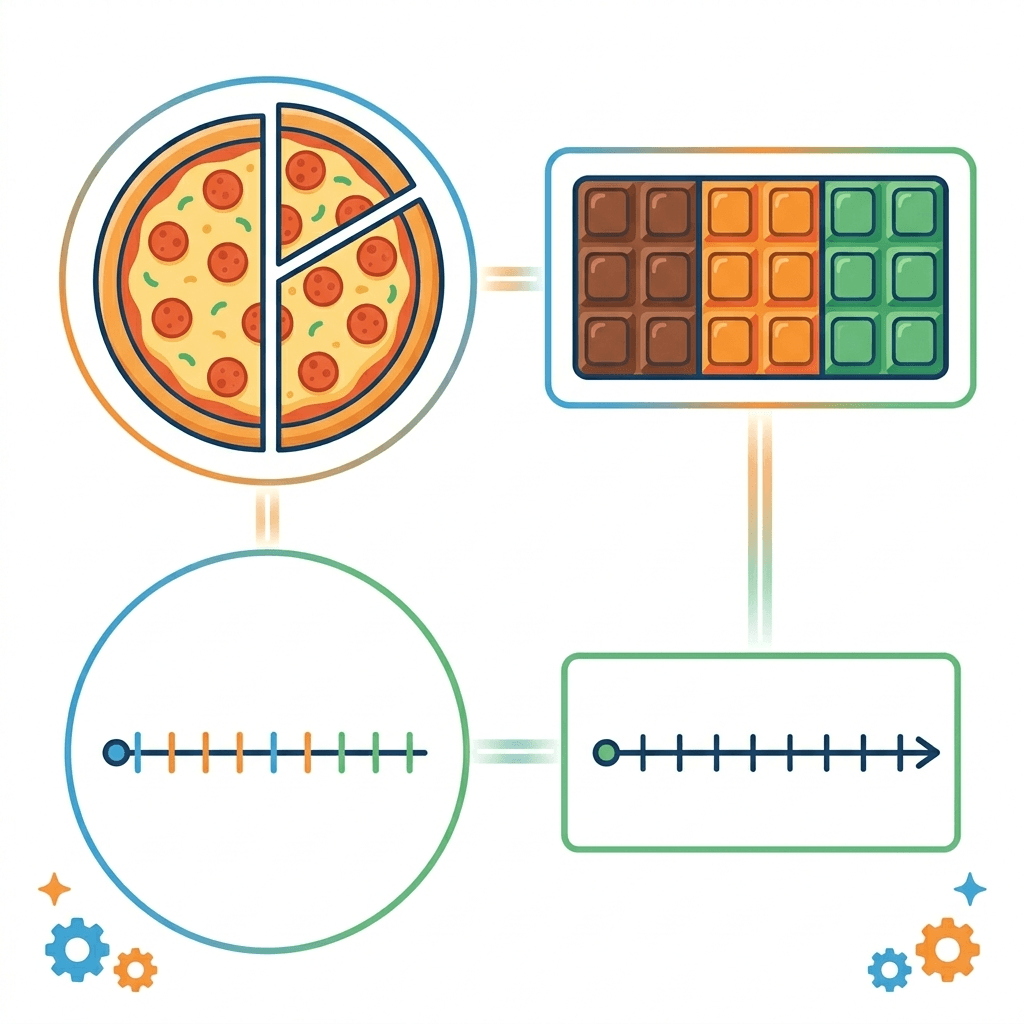
A fraction is two things at once: a picture (one slice of three) and a number (1/3). Kids who only see the symbols can't reason about "is 3/8 closer to 0 or to 1?" Kids who only see the pictures can't compute. The two must develop in lockstep — and most curricula present them sequentially, weeks or months apart.
3. Equivalent fractions feel "wrong"
Telling a child that 1/2 = 2/4 = 4/8 = 50/100 looks, at first, like cheating. The numbers are different. The names are different. How can they be equal? Without a strong visual model — same slice of pizza, just cut more times — "equivalent fractions" stays a rule kids memorise and forget. With the visual model, it's obvious.
4. Operations break the number-line that worked before
Adding whole numbers always makes them bigger. Multiplying whole numbers always makes them bigger. Then fractions arrive: 1/2 × 1/2 = 1/4, which is smaller. "Multiply" no longer means "more." Without a moment that names this clearly, kids start to distrust the operations themselves.
The 3 things that actually work
Visual models first, symbols second
Always start with a picture. Pies, fraction bars, a number line marked at 0 and 1 with halves and thirds. Children build symbolic understanding fastest when they can see the magnitudes side-by-side. Move to symbols only after the visual is fluent — usually a couple of weeks of mixed practice.
Build equivalence by re-cutting, not by rules
Don't teach "multiply top and bottom by the same number." Show the same physical pizza cut into 2 pieces, then 4, then 8. Each time, half the pizza is half the pizza. The rule is what's true *because* of the picture — not the other way round. Kids who learn the rule without the picture never trust it.
Practice across contexts — cooking, time, money
Fractions are everywhere outside the textbook. ¼ teaspoon, ⅓ cup, half past three, 75 cents is three-quarters of a dollar. Pull fractions out of the maths book and into Tuesday's pancakes. Kids who only meet fractions on a worksheet think fractions only matter on worksheets.
How to know if your child needs more practice or more confidence
Watch what happens when they get a fractions problem wrong. If they self-correct quickly when shown the picture, they have the concept and need more reps to make it automatic — that's a practice problem. If they freeze, guess, or reach for a rule they can't explain, they have a confidence problem rooted in shaky understanding — and more drills will make it worse, not better.
When in doubt, hand them a piece of paper and ask: "Draw me 3/4." If they can draw it, the foundation is there. If they can't, go back to visual models for two weeks before any worksheet.
How Samio teaches fractions
Samio Learning teaches fractions visually first — fraction bars, equal-size groups, pictures kids can manipulate. Symbols arrive only after the visual model is solid, and the adaptive engine notices when a child's intuition falters and steps back automatically. We've found this approach turns the fractions cliff into a slope. Try it free on iPad and Android.
Frequently asked questions
At what age should kids start learning fractions?
Most curricula introduce simple fractions (halves, quarters) around age 7. Equivalent fractions and operations come around 9–10. The exact age matters less than readiness — children should be confident with whole-number operations and able to reason about parts of a whole (slicing pizza, sharing toys).
My child knows the rules but still gets fraction problems wrong. Why?
This is the classic sign of "surface understanding": the rules were memorised without the underlying concept. Go back to visual models — fraction bars, pies, number lines — and have your child explain why a rule works using a picture. Once they can explain, the rules stick.
How long should fractions practice take per day?
Short and consistent beats long and rare. 10–15 minutes a day, four or five days a week, is more effective than an hour-long session once a week. Adaptive learning apps that adjust difficulty automatically save time because they target the exact gap rather than re-teaching everything.