Every child learns at a different pace. A 7-year-old who breezes through addition might struggle with reading comprehension, while her classmate does the opposite. Traditional educational tools — worksheets, textbooks, and even most apps — ignore this. They deliver the same content at the same difficulty to every student.
Adaptive learning changes this. It's the idea that technology should adjust to the learner, not the other way around. And among educational apps for kids ages 4–12, Samio Learning has built one of the most comprehensive adaptive learning engines available today.
What is adaptive learning?
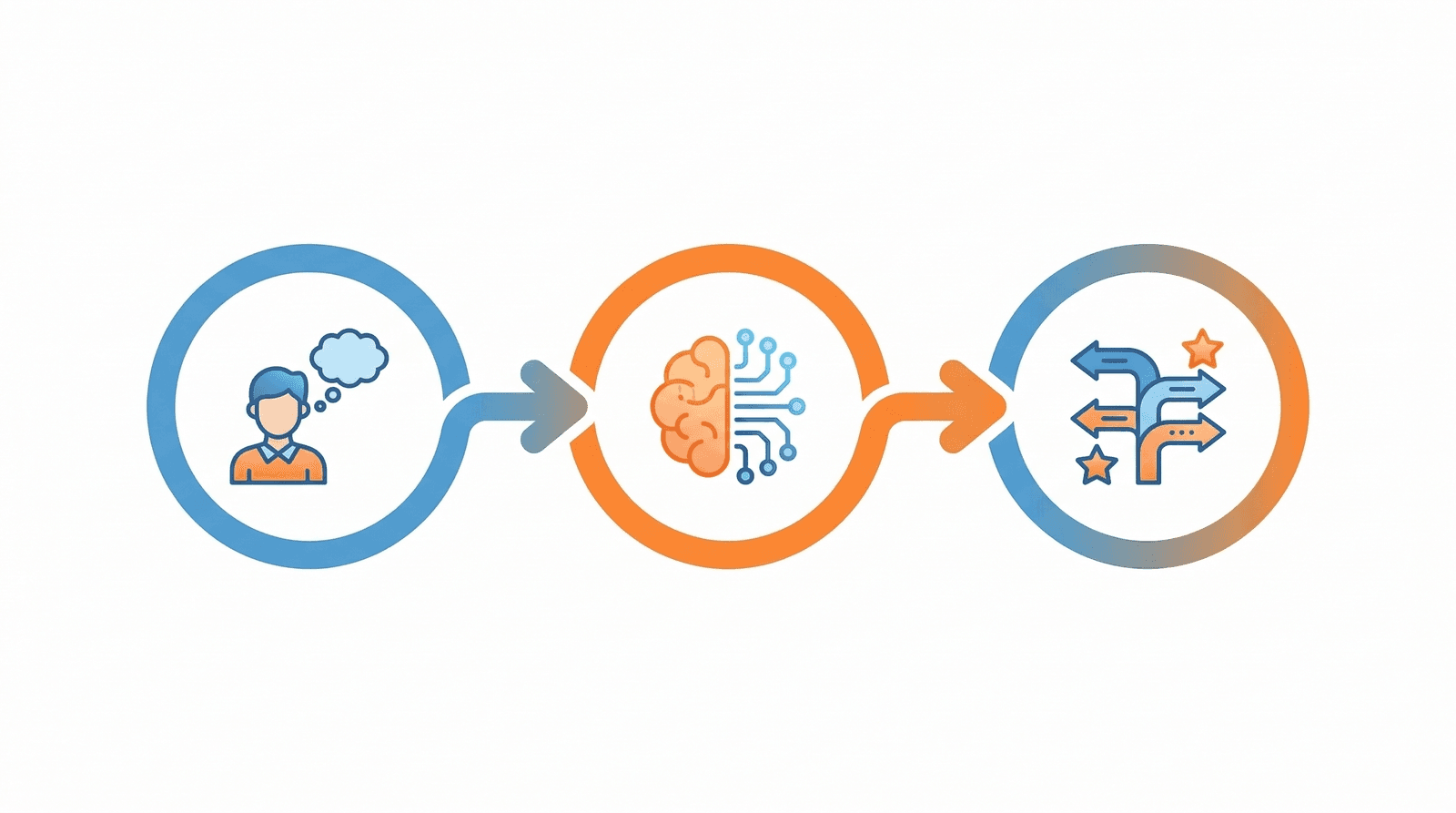
Adaptive learning is an educational approach where the content, difficulty, and pacing of exercises automatically adjust based on each student's performance. Instead of following a fixed sequence, the system responds in real time — making things harder when a child is succeeding and easier when they're struggling.
Think of it like a tutor who knows exactly when to push you forward and when to slow down. The difference is that this tutor can work with 30 students simultaneously, each on their own path.
The concept has existed in educational research since the 1970s, but it's only with modern computing and data analysis that it's become practical for everyday use in classrooms and at home.
How does adaptive learning work?
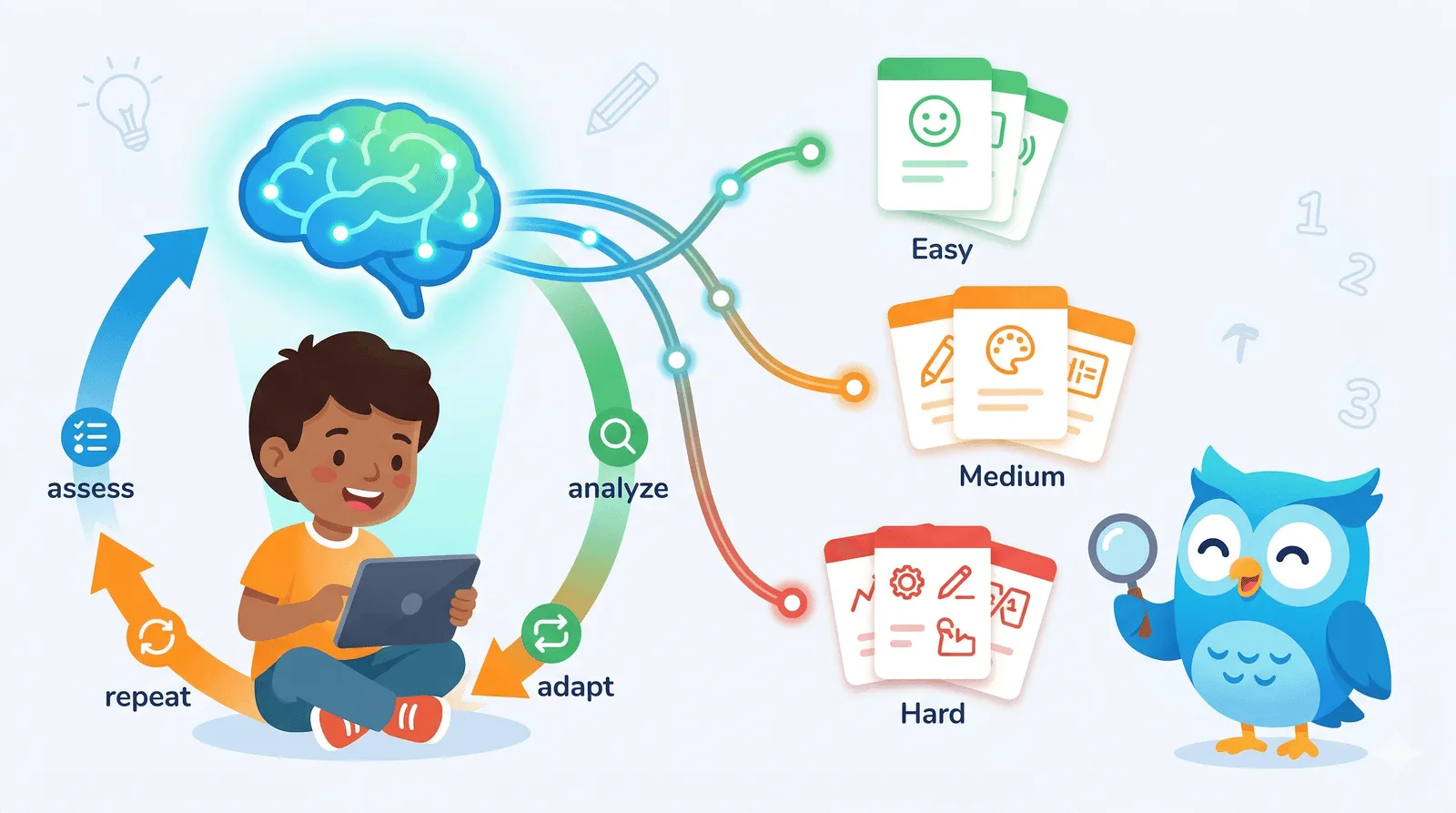
At its core, adaptive learning follows a continuous feedback loop:
- Assess — the student completes an exercise, and the system records accuracy, response time, and error patterns
- Analyze — an algorithm evaluates performance against the student's history and the expected difficulty curve
- Adapt — the next exercise is selected or generated at the optimal difficulty level — challenging enough to promote growth, but not so hard that it causes frustration
- Repeat — every new response refines the model, making the adaptation more precise over time
Why adaptive learning matters for children
Children ages 4–12 are in a critical window for foundational skills. Unlike older students who can self-regulate and seek help, young learners depend on the environment to meet them where they are. Adaptive learning provides this automatically:
- Prevents frustration — children who are behind don't face exercises they can't solve, reducing anxiety and dropout
- Prevents boredom — advanced students aren't stuck repeating what they already know
- Builds confidence — consistent success at the right challenge level creates a positive learning cycle
- Maximizes learning time — every minute of practice is spent at the productive struggle zone, not too easy and not too hard
- Supports differentiated instruction — teachers don't need to create separate materials for different levels
- Works across all subjects — reading, math, writing, grammar, and more can all benefit from adaptive pacing
Adaptive learning vs static content
Most educational apps and platforms still use static content — fixed sequences of exercises that every student goes through in the same order. Here's how they compare:
| Difficulty | Adaptive | Static |
|---|---|---|
| Difficulty adjustment | Automatic per student | Same for everyone |
| Pacing | Student-driven | Fixed sequence |
| Time to mastery | Varies by student — efficient | Fixed — some waste time, others fall behind |
| Student engagement | High — right level of challenge | Low — too easy or too hard |
| Teacher workload | Lower — system handles differentiation | Higher — must create leveled materials |
| Data insights | Rich — tracks growth over time | Minimal — completion only |
How Samio implements adaptive learning
Samio Learning doesn't just adjust difficulty randomly. The adaptive engine works across five subjects — reading, mathematics, writing, grammar, and clock reading — each with its own progression model built on a 7-stage curriculum framework.
Here's what makes Samio's approach different from other apps:
- Per-subject adaptation — a child might be at stage 5 in math but stage 3 in reading. Samio tracks each subject independently, so strength in one area doesn't mask weakness in another.
- Granular difficulty control — within each stage, exercises vary in complexity. The system doesn't just move between stages — it fine-tunes within them based on accuracy and response patterns.
- Error pattern analysis — Samio doesn't just count right vs wrong answers. It tracks what types of errors a student makes (e.g., confusing similar letters, making carry-over mistakes in math) and targets those specific weaknesses.
- Spaced repetition — concepts a student previously struggled with reappear at calculated intervals, reinforcing retention without overwhelming the session.
- Daily calibration — each session starts with a brief calibration set that updates the difficulty model, ensuring the system stays current even if a child takes a break.
- Multi-language adaptation — the adaptive engine works identically across all 7 supported languages (English, Spanish, Dutch, French, German, Portuguese, Italian), with language-specific content for each difficulty level.
Samio vs other adaptive learning apps
Several popular educational apps claim adaptive features, but the depth varies significantly. Here's an honest comparison:
| Subjects | Samio | Khan Academy | Duolingo | IXL |
|---|---|---|---|---|
| Subjects covered | 5 (reading, math, writing, grammar, clock) | Math + reading | Language only | Math + language arts |
| Age range | 4–12 | 2–8 | All ages | Pre-K to 12 |
| Adaptation depth | Per-subject, per-skill, error analysis | Basic mastery tracking | Spaced repetition | Diagnostic + recommendations |
| Curriculum alignment | 7-stage structured curriculum | Topic-based | CEFR levels | Standards-aligned skills |
| Teacher dashboard | Full analytics + custom challenges | Basic class reports | Duolingo for Schools (limited) | Reports + diagnostics |
| Languages | 7 languages (content + UI) | English + Spanish | 40+ (language courses) | English + Spanish |
| Privacy (children) | Nicknames only, COPPA compliant | Requires parent account | Email or Google account | Requires parent/school account |
| Offline support | Core exercises work offline | Limited (video streaming) | Paid plan only | Online only |
Khan Academy Kids is an excellent free resource, but its adaptive features are basic — it advances students through topics based on completion, not fine-grained performance analysis. Duolingo's spaced repetition is effective for vocabulary but only covers language. IXL offers diagnostics but can feel repetitive, and its adaptive model is primarily skill-based rather than difficulty-based. Samio combines multi-subject coverage, deep adaptation, and a classroom dashboard — making it the most complete adaptive learning tool specifically designed for primary education.
What adaptive learning looks like in practice
When a child uses Samio daily for 10–15 minutes, the adaptive engine produces measurable effects:
- Within the first week — the system establishes a baseline and begins personalizing difficulty. Early sessions may fluctuate as the model calibrates.
- After 2–3 weeks — accuracy stabilizes at 70–85% (the optimal learning zone). Students are consistently challenged but not frustrated.
- After 6 weeks — teachers can see clear progression through curriculum stages. Weaker areas show targeted improvement because the system has been systematically addressing gaps.
- Ongoing — the system prevents skill regression by reintroducing previously learned concepts at intervals, maintaining long-term retention.
Adaptive learning in the classroom with Samio for Schools
Adaptive learning is powerful on its own, but it becomes transformative when teachers can see what's happening. Samio for Schools provides a real-time dashboard that turns the adaptive engine's data into actionable insights:
- Per-student accuracy trends — see which students are improving, plateauing, or struggling over time
- Skill gap identification — pinpoint exactly which skills need attention (e.g., 'Maria struggles with fractions involving unlike denominators')
- Class-level patterns — spot common weaknesses across the class to inform whole-group instruction
- Custom challenges — create targeted exercises for specific skills, overriding the adaptive engine when you want to focus on a particular topic
- Progress reports — generate shareable reports for parent meetings, IEPs, or school leadership
- Time-on-task analytics — see how much time each student spends and how efficiently they practice
Getting started with adaptive learning on Samio
For parents: download Samio Learning from the App Store or Google Play. Create a child profile (nickname and age only — no personal data needed). The adaptive engine begins working from the very first exercise. Within 2–3 sessions, your child will be receiving personalized content.
For schools: sign up for Samio for Schools and add your students. Start with one subject and one class as a pilot. Within two weeks, you'll have enough data to see the adaptive engine's impact on individual student progress.
FAQ
What is adaptive learning in simple terms?
Adaptive learning means the app automatically makes exercises easier or harder based on how your child is doing. If they get answers right, it gets harder. If they struggle, it gets easier. This keeps them learning at just the right level.
How is Samio's adaptive learning different from other apps?
Samio adapts across 5 subjects independently, analyzes specific error patterns (not just right/wrong), uses spaced repetition, and recalibrates daily. Most other apps only adjust based on simple completion or basic scoring.
Does adaptive learning really work for young children?
Yes. Research consistently shows that adaptive systems improve learning outcomes for children, particularly ages 4–12 where foundational skills are being built. The key is maintaining the 'productive struggle zone' — challenging enough to grow, but not so hard they give up.
Can teachers override the adaptive system?
Yes. With Samio for Schools, teachers can create custom challenges that target specific skills or topics. This lets you supplement the adaptive engine with direct instruction when needed.
Is my child's data safe with adaptive learning?
Samio uses nicknames and age ranges only — no real names, email addresses, or personal information. The adaptive data (exercise performance) is used solely to personalize the learning experience. Samio is fully COPPA compliant.