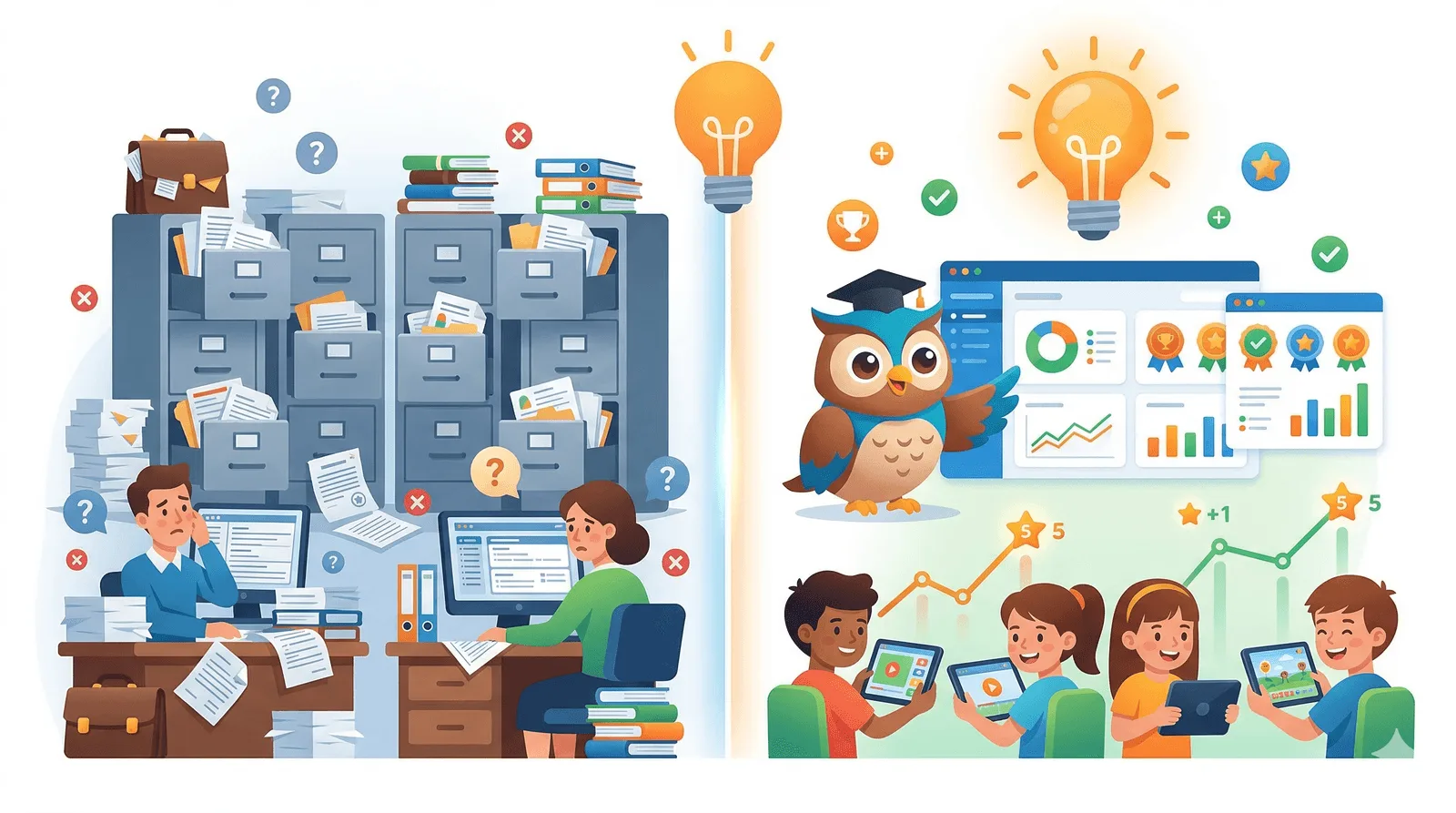
Schools today are flooded with edtech options — from basic homework tools to full-blown learning management systems. Most of them weren't designed for primary education. They're built for universities, then scaled down with simplified interfaces. The result? Teachers waste time on setup and admin, while students don't get the targeted, adaptive practice they need.
Samio Learning was built from the ground up for primary schools — ages 4 to 12. This article covers what Samio is, why it's different from traditional LMS platforms, and what concrete advantages it offers schools looking for measurable learning outcomes.
What is Samio?
Samio Learning is an adaptive educational platform for children aged 4–12 that covers five core subjects: reading, mathematics, writing, grammar, and clock reading. Unlike most educational apps that focus on a single subject or act as a content library, Samio provides structured, curriculum-aligned exercises with adaptive difficulty — every student works at their own level automatically.
The platform has two faces: a student-facing app available on iOS and Android, and Samio for Schools — a full classroom management dashboard for teachers and administrators. Together, they close the loop between independent practice and classroom instruction.
- Reading — 6 stages from letter recognition to complex sentence comprehension
- Mathematics — counting, operations, fractions, decimals, unit conversions, and more
- Writing — sentence construction, word ordering, and spelling exercises
- Grammar — rules, sentence correction, and contextual grammar practice
- Clock reading — analog and digital clocks with progressive difficulty
Why schools need Samio
Primary schools face a universal challenge: every student in the same classroom is at a different level. Teachers know this, but traditional tools don't solve it. A worksheet set to one difficulty level fails students who are ahead and frustrates those who are behind. Samio addresses this directly:
- Adaptive difficulty — exercises adjust in real time to each student's performance, so no child is bored or overwhelmed
- Real-time analytics — teachers see exactly where each student stands without waiting for test results
- Consistent daily practice — built-in goals and streaks encourage 10–15 minutes of focused practice every day
- Curriculum alignment — content follows a structured 7-stage system aligned with primary education standards
- Multi-language support — interface and content available in 7 languages, ideal for multilingual classrooms and international schools
- Privacy by design — students use nicknames and age ranges only, fully COPPA compliant
Samio vs traditional LMS platforms
Most schools already use some kind of digital tool — Google Classroom, Canvas, Moodle, or similar. These are general-purpose learning management systems designed primarily for content distribution and assignment management. They work well for what they do: sharing documents, collecting homework, and communicating with parents.
But they don't teach. A traditional LMS is a filing cabinet — it organizes. Samio is a tutor — it adapts, practices, and reports. Here's how they differ:
| Feature | Samio | Traditional LMS |
|---|---|---|
| Purpose | Adaptive learning & practice | Content distribution & assignment management |
| Target age | Ages 4–12 (primary education) | All ages (often designed for higher ed) |
| Adaptive difficulty | Yes — adjusts per student automatically | No — same content for all students |
| Built-in exercises | Thousands across 5 subjects | None — teachers must create or source content |
| Real-time student analytics | Per-student accuracy, time, and progress tracking | Submission tracking only |
| Teacher setup time | Minutes — pre-built curriculum | Hours — must build courses, upload materials |
| Device management | Auto-accept for shared classroom tablets | Requires separate MDM solutions |
| Privacy (primary students) | Nicknames only, COPPA compliant | Often requires real names and email |
Key advantages of Samio for schools
- Zero content creation — the curriculum is built in. Teachers don't need to create, curate, or upload exercises. The 7-stage adaptive curriculum covers reading, math, writing, grammar, and clock reading out of the box.
- Differentiated instruction at scale — 30 students in one classroom can each work at a different difficulty level simultaneously. The system adjusts automatically based on accuracy and response patterns.
- Actionable teacher dashboard — see per-student accuracy trends, time spent, and skill gaps in real time. Generate reports for parent meetings, school leadership, or external evaluations.
- Custom challenges — teachers can create targeted exercises for specific learning objectives, addressing individual student needs or reinforcing classroom topics.
- Multi-subject coverage — instead of subscribing to separate apps for reading, math, and writing, Samio covers 5 subjects in one platform with one login and one dashboard.
- Built for shared devices — auto-accept device management and nickname-only student profiles make it practical for schools where multiple students share tablets.
- Affordable pricing — $4.99/month Homeschool (10 students), $19/month Classroom (60 students, 1 teacher, 4 classes), or $159/month School (1,500 students, unlimited teachers). Schools in lower- and middle-income countries pay 50–75% less under equity pricing. No per-student pricing surprises.
- 7 languages — English, Spanish, Dutch, French, German, Portuguese, and Italian. Supports ESL/EAL students and international school settings.
How Samio compares to specific platforms
Each of these platforms serves a different purpose. Samio doesn't replace all of them — but it fills a gap none of them address:
Samio vs Google Classroom
Google Classroom is excellent for distributing assignments, collecting homework, and communicating with students and parents. But it has no built-in learning content — every exercise must be created or linked by the teacher. It also doesn't offer adaptive difficulty or per-student analytics. Schools that use Google Classroom can add Samio alongside it: Google Classroom handles the workflow, Samio handles the adaptive practice. Samio integrates with Google Classroom via OAuth 2.0 for roster syncing.
Samio vs Canvas / Blackboard
Canvas and Blackboard are enterprise LMS platforms designed for higher education. While some primary schools use Canvas via district licenses, the interface is complex and content must be built from scratch. Samio provides ready-made, adaptive exercises that require no content creation. For schools with existing Canvas deployments, Samio connects via LTI 1.3 for seamless single sign-on and grade passback.
Samio vs Moodle
Moodle is a powerful, open-source LMS with deep customization — but that customization requires technical expertise. Setting up Moodle for a primary school typically requires IT administration, plugin management, and custom course building. Samio requires no IT setup. Teachers can onboard students and start in minutes. Schools that already use Moodle can add Samio via LTI 1.3 integration without disrupting their existing setup.
Samio vs ClassDojo
ClassDojo focuses on behavior management and parent communication — it's a classroom culture tool, not a learning tool. It doesn't provide exercises, adaptive difficulty, or curriculum content. Schools that use ClassDojo for behavior and communication can use Samio alongside it for structured academic practice.
Integration with existing platforms
Samio doesn't require schools to abandon their current tools. It integrates through industry-standard protocols: LTI 1.3 for platforms like Moodle, Canvas, Blackboard, Brightspace, Schoology, and Sakai — and OAuth 2.0 for Google Classroom. This means single sign-on, automatic roster syncing, and grade passback without separate logins.
LMS integrations, SSO and Edu-V are included on the School plan ($159/month). This lets IT administrators connect Samio to their existing infrastructure without changing student or teacher workflows.
Pricing for schools
Samio for Schools offers three plans designed for different sizes. Homeschool costs $4.99/month and supports up to 10 students with one parent-teacher — built for a family teaching at home. Classroom costs $19/month and supports up to 60 students, 1 teacher and 4 classes, with unlimited AI generation — ideal for an individual teacher or a small after-school programme. School costs $159/month and supports up to 1,500 students with unlimited teachers, plus advanced analytics, PDF export, LMS integrations, SSO and priority support. Those are Standard-tier prices; schools in lower- and middle-income countries automatically get equity pricing at 50% or 75% off.
Every plan includes a 14-day free trial — PayPal collects payment details up front and you can cancel anytime before the trial ends without being charged. There are no per-student fees, no setup costs, and no contracts.
Getting started
Start with a focused pilot: pick one class, one subject, and one measurable goal (e.g., improve reading accuracy by 10% in 6 weeks). Set up takes minutes — create a school account, add your students with nicknames, and assign the first exercises. Track progress daily through the teacher dashboard.
If your school already uses an LMS like Google Classroom or Moodle, connect Samio through the integration settings and start with synced rosters. No manual student entry needed.
FAQ
Does Samio replace Google Classroom or our LMS?
No. Samio complements your existing LMS. It's an adaptive learning and practice tool, not a content management system. Use your LMS for assignments and communication, and Samio for targeted, adaptive student practice.
What ages does Samio cover?
Samio is designed for children aged 4 to 12 (primary/elementary school). Content spans 7 difficulty stages across 5 subjects: reading, math, writing, grammar, and clock reading.
Is student data safe?
Yes. Samio is COPPA compliant. Students use nicknames and age ranges only — no real names, email addresses, or personal data are collected. Schools own their data.
How much does it cost?
Homeschool: $4.99/month (up to 10 students, 1 parent-teacher). Classroom: $19/month (up to 60 students, 1 teacher, 4 classes). School: $159/month (up to 1,500 students, unlimited teachers, advanced analytics, LMS integrations, priority support). Those are Standard-tier prices — schools in lower- and middle-income countries pay 50–75% less. All three include a 14-day free trial; PayPal collects payment details up front and you can cancel anytime before the trial ends without being charged.
Can we connect Samio to our existing LMS?
Yes. Samio integrates with Moodle, Canvas, Blackboard, Brightspace, Schoology, Sakai via LTI 1.3, and with Google Classroom via OAuth 2.0. Integration is available on the School plan.