Since the OECD published PISA 2025 on 8 September, the same question has arrived from parents and from schools: does Samio prepare children for PISA? The short answer is no. PISA tests 15-year-olds; Samio is built for ages 4 to 12 and there is no PISA-style test in the app. The longer answer is more useful, because the OECD's own analysis says the results at fifteen were largely decided years earlier, in primary school.
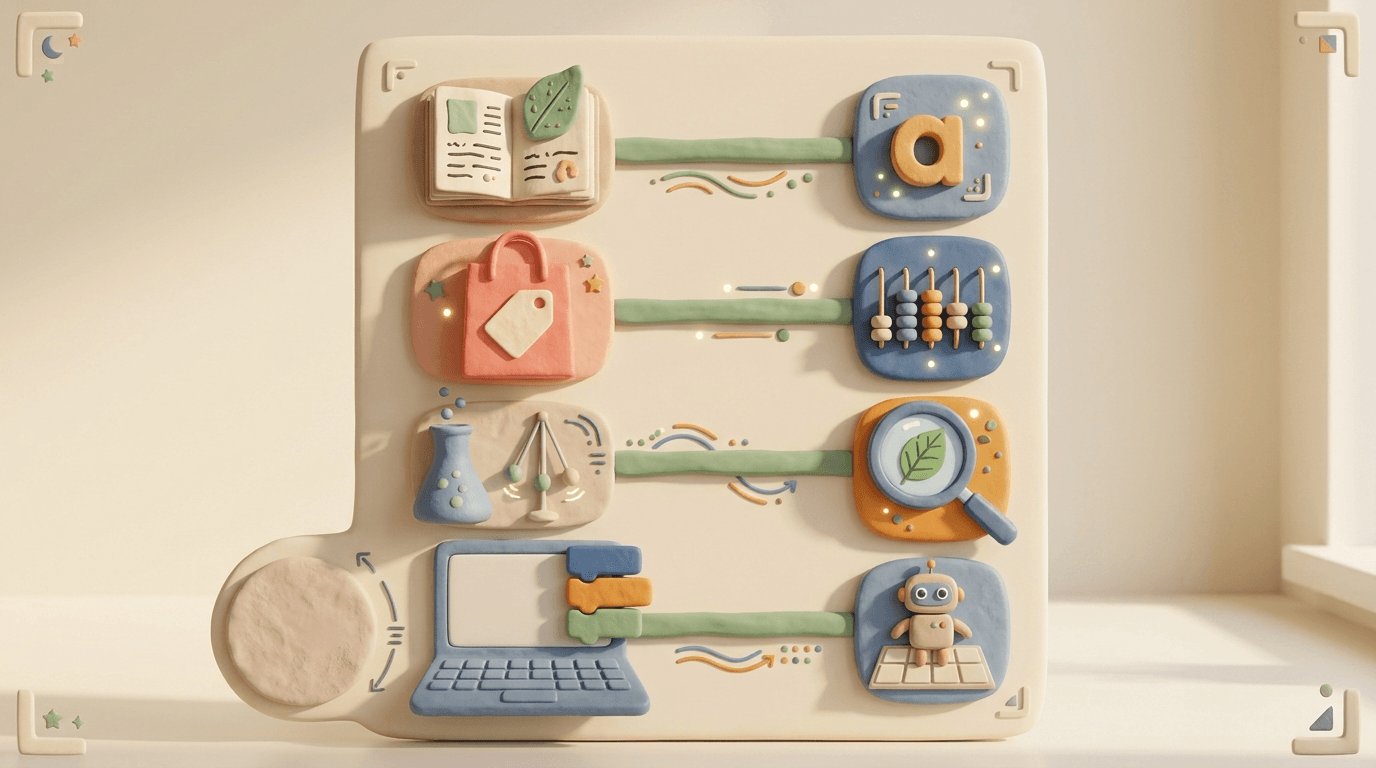
So this is our part, stated carefully. PISA measures four things: reading literacy, mathematical literacy, scientific literacy and, new in 2025, learning in the digital world, which covers computational problem solving and how well students steer their own learning. Below is what Samio practises for each, checked against what the app actually does today, and where it falls short. We would rather tell you the gaps than let you assume them.
Reading: longer texts, and questions you cannot skim
The OECD found students did worst on tasks with longer texts that require careful reading and combining several pieces of information, and that hasty, wrong answers nearly doubled. Samio's reading path runs from phonics and letter tracing at four to short passages from age seven. Passages grow from about 65 words to up to 250 by age eleven, and every passage carries questions of four kinds: literal, inferential, vocabulary and main idea. An inferential question cannot be answered by scanning for a word; the child has to have read the paragraph.
The level adapts to the child, not to the class average, so a strong reader at eight meets texts that stretch, and a struggling reader at ten is not left behind on texts that do not. Comprehension is available in all seven of Samio's languages, so a child can practise in the language spoken at home. From age eleven passages now run to 250 words with five questions, including one that asks the child to put two parts of the text together and one that asks whether a claim in the text is fact or opinion. And because the OECD found hasty, wrong answers doubling, the answer buttons stay locked until the child has had time to read the whole text and scrolled to its end; Sam says 'read it all first'. What we do not do yet: questions that compare two different texts. That belongs on our list.
Maths: numbers that show up on a receipt
A low performer in PISA mathematics cannot work out the relationship between units and price on a shopping receipt, or compare two routes. Samio's maths module goes from counting and number sense to operations, fractions and unit conversions, and its word problems are set in shopping, time, measurement, counting and sharing rather than in abstract drills. By the last stage, problems take up to three steps. A separate clock module handles analogue and digital time, the everyday skill that quietly underpins a lot of later maths.
Children from eight can now practise exactly that: a 'Charts and tables' mode shows a bar chart, a table or a pictogram and asks which is most, how many more, or what the total is. The data and the answers are generated deterministically, so the number is always right, and the mode works offline too. It is the item PISA's 'utility bill' tasks are built on, and a week ago it was the clearest gap in the maths module.
Science and computing: the two newest parts of PISA
Science in Samio starts at eight and physics at nine, covering the scientific method, life science, earth science, basic chemistry, ecosystems, forces, energy, waves, electricity and simple machines, with generated diagrams. Most items are a single question with a short explanation, which is good for learning a concept. At the higher science stages two new kinds of question move towards what PISA calls scientific literacy: 'Evidence and conclusions' gives a short observation and asks which conclusion it actually supports, and 'Fair tests' describes an experiment and asks which single variable should change. Still multiple choice, still short, but the reasoning is the point.
Computing is where Samio is closest to the new PISA domain. The OECD writes that the value of computational problem solving lies not in coding itself but in the habits it develops: logical reasoning, pattern recognition and breaking complex challenges into manageable parts. Samio's Block Puzzles do exactly that from age seven: 44 puzzles in four tiers where a child sequences moves, then discovers repeats, then nests them, and each tier unlocks after solving puzzles in the one before. From eleven, Code Detective shows short real Python and JavaScript snippets and asks the child to predict the output or spot the bug. A digital-safety strand covers passwords, personal information and kind behaviour online. Every block puzzle and code exercise is now mapped to a computing unit of the child's national curriculum, so in Samio for Schools computational thinking shows up in the same skills, competencies and progress views as reading and maths.
Attention and habits: the part no module can replace
The OECD's blunt summary is that the reading decline mainly reflects a loss of focus and attention, and it links digital distraction in class to lower scores. Samio is designed against that grain. There is no feed, no ads and nothing to scroll, and parents can set a daily time limit after which Sam says that is enough for today. Parent settings sit behind a gate and show progress per subject, with a report that explains what a level actually means rather than a bare number.
The OECD also found that only 37% of 15-year-olds plan how they study, and that students who set their own goals do better. So Samio now asks each child how many exercises they want to do today, five to twenty, with rows of stars for the youngest, and when the goal is reached Sam asks one question: did your plan work? Parents see the answers for the last seven days and the minutes actually practised, measured per exercise instead of estimated. Plan, do, check: the habit the OECD asks for, at an age when it still becomes a habit.
For schools: what a head teacher can say about PISA
If a school board asks how the platform responds to PISA 2025, the honest answer is this. Every exercise a class does in Samio for Schools is mapped to the national curriculum of the country, built from official sources for more than fifty country and language combinations, and the dashboard shows skills, competencies and assessment criteria per class and per student, with alerts for who is behind. A placement test shows the level each child is actually working at, and teachers hand out curriculum-grounded challenges and lessons in minutes.
The dashboard does not print a PISA label on anything, and it will not. What it does show is the new items under the names your own curriculum uses: chart and table exercises land on the data-and-graphs topics, evidence questions on the scientific method, longer passages on reading comprehension and block puzzles on computing, per class and per child. Teachers see practice time as real minutes. What a school gets is earlier visibility of the same gaps, in the years the OECD says they open.
See what Samio for Schools shows a head teacher today →
Frequently asked questions
Does Samio prepare children for the PISA test?
No. PISA tests 15-year-olds and Samio is a primary-school platform for ages 4 to 12 with no PISA-style test. Samio practises the foundations the OECD says PISA results are built on years earlier: careful reading, maths in everyday contexts, early science and computational thinking.
Which of the skills PISA measures does Samio practise today?
Reading comprehension with literal, inferential, vocabulary, main-idea, integrate and evaluate questions on passages up to about 250 words, with answers locked until the text has been read; maths word problems in shopping, time, measurement and sharing contexts with up to three steps, plus charts, tables and pictograms from age eight; science and physics concepts from age eight, with evidence-and-conclusion and fair-test questions at the higher stages; and computational problem solving through block puzzles from seven and code reading from eleven. All in seven languages, adapted to the child's level. Children also set their own daily goal and check in with Sam when they reach it.
What does Samio not do yet?
Questions that compare two different texts; free-text answers in science, where every item is still multiple choice; and any PISA-style score or label, which we will not invent for children of primary age. We list them because a family or a school choosing a tool deserves the gaps as much as the features.
How should a school use Samio in response to PISA 2025?
Run the placement test early in the year to see where each child actually is, use the curriculum analytics to find the skills a class is behind on, and hand out short daily practice rather than long sessions. The OECD's data favour limited, purposeful device use over open-ended screen time, and short structured sessions are what Samio is built for.