
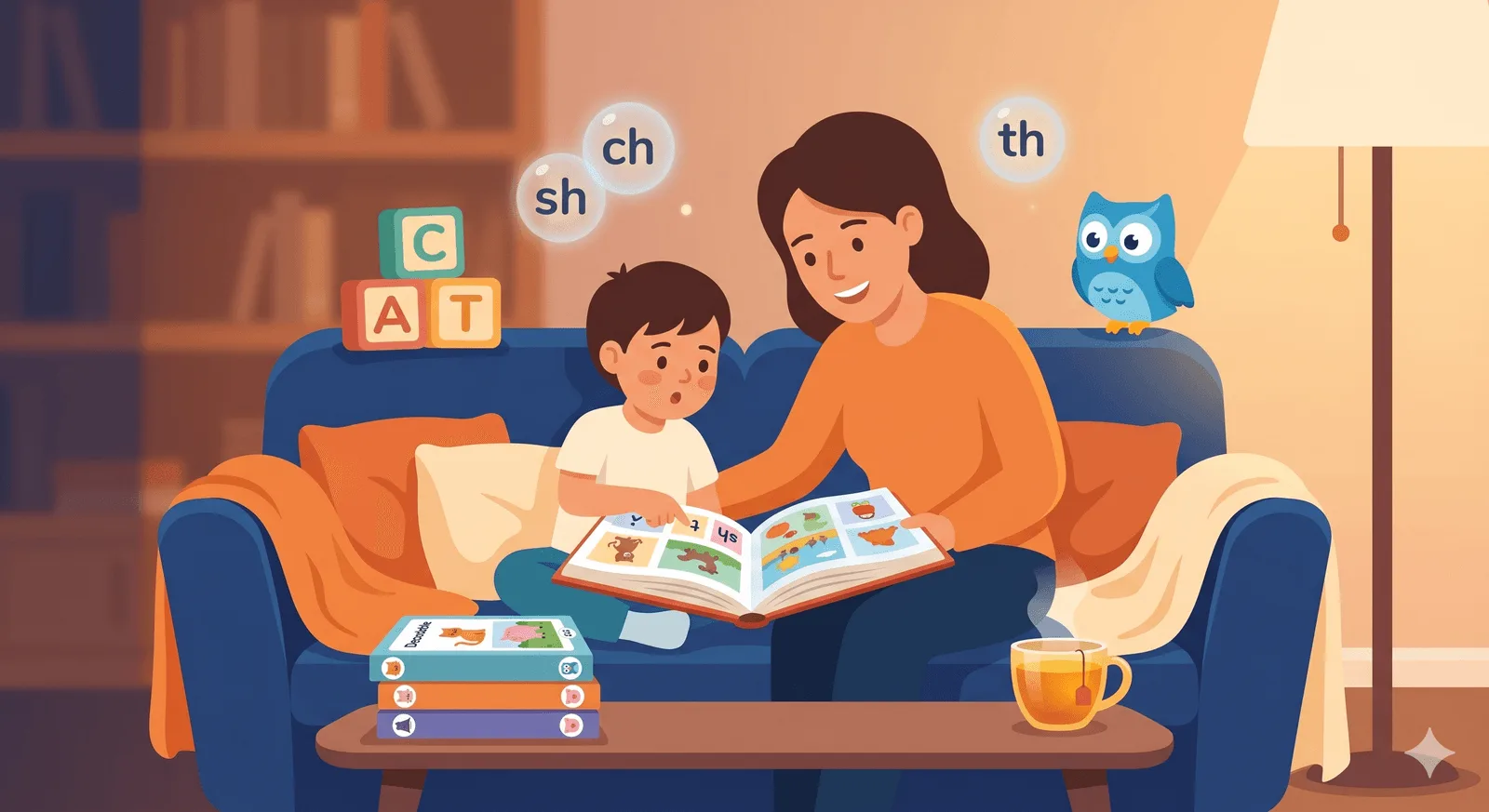
Teaching your child to read at home sounds intimidating. There's no shortage of advice and most of it contradicts itself. Phonics? Whole-language? Sight words? Apps? Forty years of reading research has produced one clear answer — and it isn't "all of the above."
This guide is the honest version. What works, in what order, and what to skip. Twenty minutes a day, five days a week, is enough to take a 4-year-old from "sound out the letters" to confident chapter-book reading by age 8.
What the science actually says
The reading wars are over. Decades of evidence — most clearly synthesised in the National Reading Panel report and the more recent UK Rose Review — converge on one approach: systematic phonics. Children who learn the sound-letter code first read better, faster, and longer than children taught by whole-word memorisation or guessing from context.
This doesn't mean phonics alone. Reading is sounds, words, sentences, and meaning, all woven together. But the sequence matters: code first, comprehension second. Get the decoding fluent, and comprehension follows naturally because the brain isn't stuck on "what is this word?"
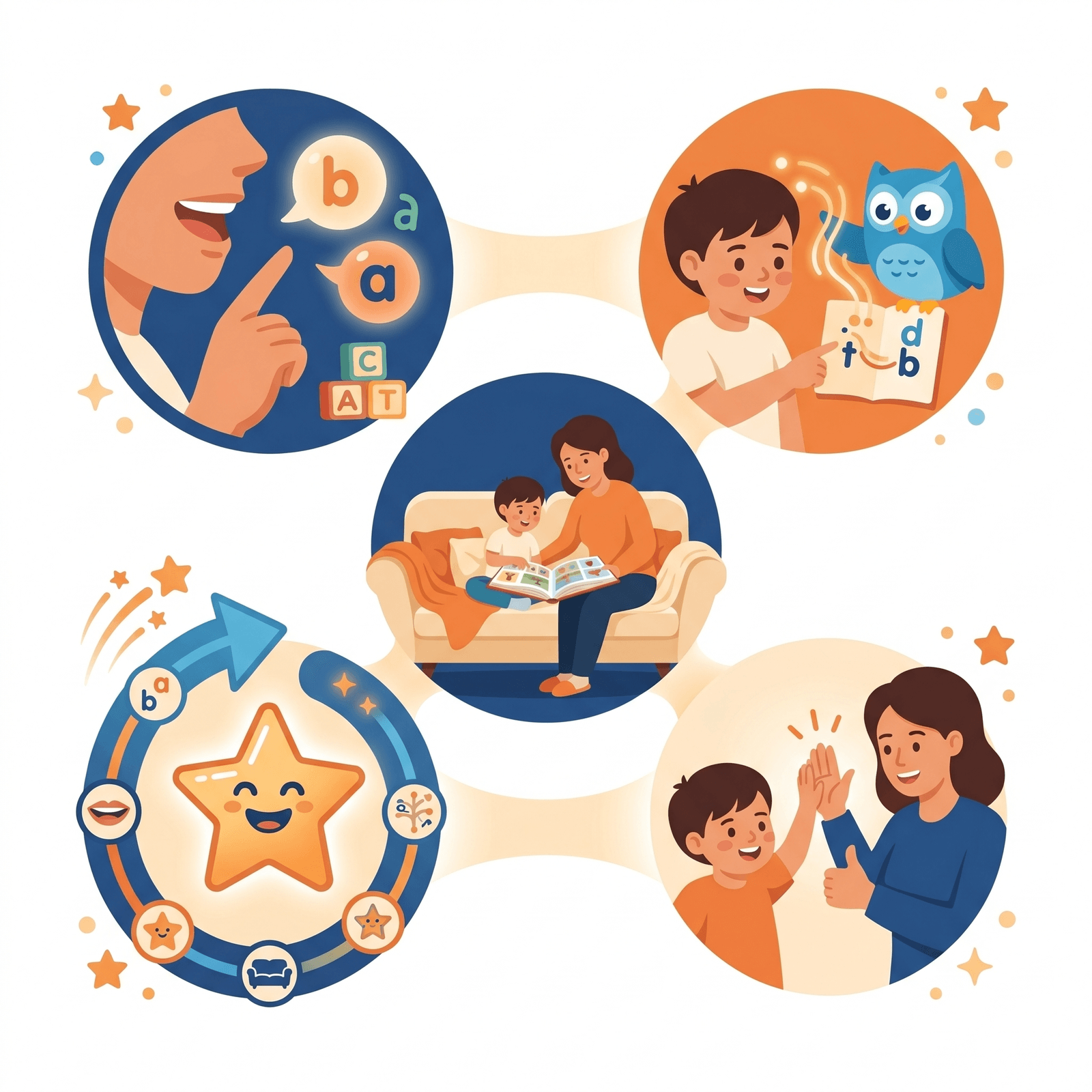
The 5-step approach
Step 1: Letter sounds, not letter names
Don't teach "em-em" for M. Teach the sound /m/ as in "mum." Letter names are useful for spelling out loud but useless for reading. Cover all 26 letters first — the sounds, not the names. Twenty seconds per letter, two new letters a day, and you're through the alphabet in under two weeks.
Step 2: Blend the sounds
Once your child knows c, a, t as sounds, blend them: /c/ /a/ /t/ → cat. This is the "aha" moment. Some kids get it instantly. Some take weeks. Don't push past it — blending is the foundational skill. Once it clicks, dozens of words unlock at once. Practice with 3-letter consonant-vowel-consonant words: cat, hat, sit, pin, top, run.
Step 3: Add common patterns (digraphs)
Two letters that make one sound: sh, ch, th, ck, ng. Then long-vowel patterns: ai, ee, oa, igh. Each pattern unlocks another wave of words. Take it slow — one new pattern every few days, with practice on the previous ones built in. Don't drown your child in rules; let them notice patterns by reading lots of examples.
Step 4: Sight words for the irregulars
Some words don't follow phonics rules cleanly: "the," "was," "said," "come." These need to be memorised. Drill maybe 10 sight words a week, no more. Sight words are the EXCEPTION, not the rule — and a phonics-first child only needs about 100 of them total to read fluently.
Step 5: Real books, every day
From day one of step 1, read together every day. Picture books while they're learning sounds. Decodable readers (books written for the phonics patterns they've learned) once they can blend. Then chapter books. Reading without books is like swimming without water — the practice has to be in real text.
Read aloud — non-negotiable
Reading TO your child matters as much as teaching them to read. Vocabulary, grammar, story structure, attention span — they all develop through being read aloud to. Children who are read to daily start school with thousands more words in their vocabulary than children who aren't.
Twenty minutes of read-aloud at bedtime is enough. Don't stop reading aloud once they can read on their own — keep going to ages 10, 11, 12. The reading level you can read TO them is years ahead of what they can read alone, and that gap is where vocabulary growth happens.
When to bring in apps
Apps are not a substitute for a parent and a book — but they're useful for two specific things. First, drilling phonics patterns to automaticity (the boring repetition that's hard to make a parent enjoy). Second, decodable readers — apps can store dozens of them and adapt difficulty automatically.
Look for apps that teach phonics systematically (not whole-word guessing), give immediate feedback on sounds, and don't reward random clicking. Avoid apps that teach "reading" through games where the child never actually reads.
How Samio teaches reading
Samio Learning teaches reading the way the research says it works. Phonics first — letter sounds, then blending, then digraphs, then long vowels — with adaptive difficulty so each child progresses at their pace. Decodable practice text built around the patterns they've learned. Sight words drilled separately, not blended in. We made the boring drill part fun, so the adult-to-child reading time can stay for the books. Free on iPad and Android, available in 7 languages.
Frequently asked questions
When should I start teaching my child to read?
Anywhere from 4 to 6 is normal. Some children are ready at 3, some at 7, and that's all fine. Readiness signs: interest in books, asking what words say, recognising some letters, holding a pencil. If they're not interested at 4, don't force — try again in three months.
How long should daily reading practice be?
15–20 minutes for ages 4–6. 20–30 for ages 7–8. Short and consistent beats long and rare. One reading-aloud session of 20 minutes, plus 10 minutes of phonics practice, is plenty. More than 45 minutes and you're past diminishing returns.
My child memorises words rather than sounding them out. Is that a problem?
Yes — and a common one. It often comes from whole-word teaching or from a child who's quick but skipped foundational phonics. Go back to letter sounds and blending, even if they're "reading" already. Real reading fluency requires the phonics code; memorisation hits a wall around 200 words.
What if my child reads slowly?
Reading slowly at first is normal — and good. It means they're decoding, not guessing. Speed comes from practice, not from being pushed. A child who reads slowly but accurately at 5 will read fluently at 7. A child who reads fast but inaccurately at 5 has a problem developing.