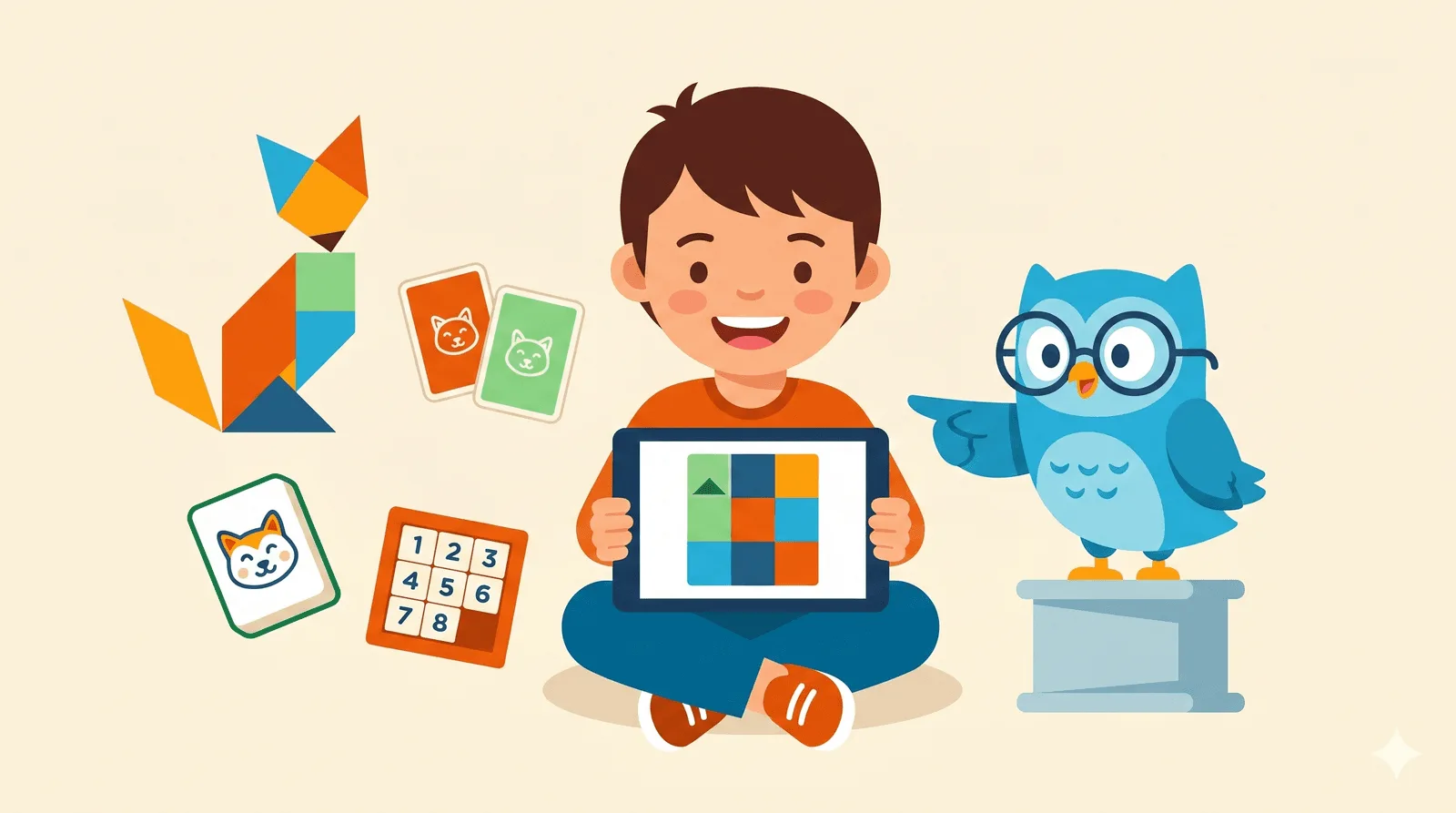
Long before a child can read a single word, they can solve a puzzle. That's the quiet magic of logic puzzles for kids — they teach the brain to plan, remember, and persist using nothing but shapes, pictures, and the satisfying click of a piece falling into place.
Logic puzzles aren't filler between "real" learning. They are some of the most concentrated thinking practice a young child can get. This guide breaks down why they matter, what the four classic puzzle types each build, and how to use them so your child grows from the challenge instead of giving up on it.
Why logic puzzles matter for young children
A good puzzle forces a child to do something school rarely asks of a four-year-old: hold a goal in mind, try a move, see what happened, and adjust. That single loop trains four foundations at once — spatial reasoning (how shapes fit and rotate), working memory (keeping pieces and positions in mind), pattern recognition (spotting what repeats or matches), and persistence (staying with a problem long enough to crack it).
What makes puzzles special for the youngest learners is that they need no reading at all. A pre-reader who can't yet decode a sentence can still plan three moves ahead, remember where a hidden pair was, or see that two shapes will make a square. Puzzles let thinking skills race ahead of reading skills — which is exactly the head start a young brain wants.
The four classic puzzle types and what each builds
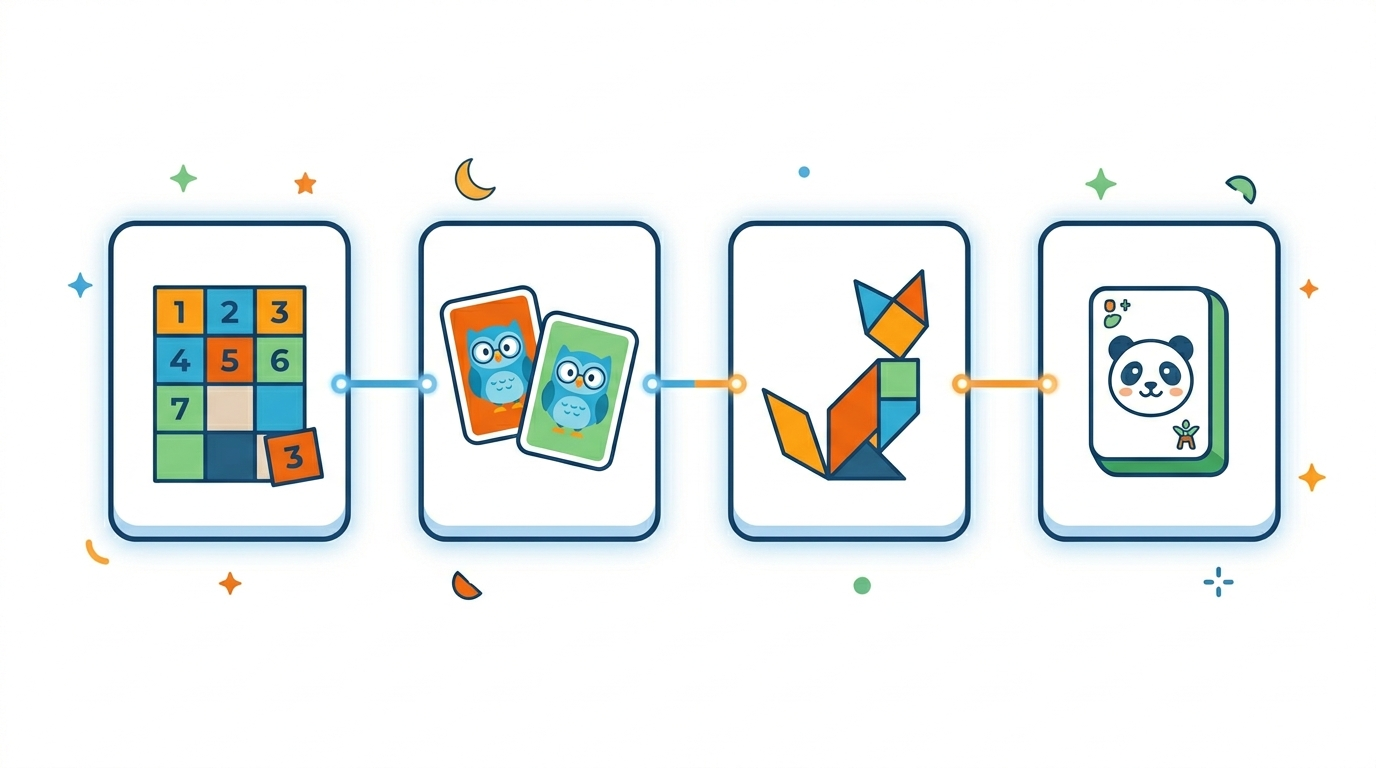
Not all puzzles train the same muscle. Sliding (tile) puzzles are about planning and sequencing: you can't move every piece directly, so the child has to think in steps, often undoing progress to set up the next move. Memory or find-the-pairs matching is pure working memory: flip a card, hold its picture and place in mind, and link it to its twin turns later. Both teach the brain to keep information alive while doing something else.
Tangrams and shape-building puzzles develop spatial reasoning and early geometry — children rotate, flip, and combine shapes to fill an outline, building an intuition for how forms relate long before any geometry lesson. Animal mahjong solitaire trains visual scanning and planning: the child sweeps the board for matching tiles and learns to clear them in an order that doesn't trap the pieces underneath. Four puzzle types, four different thinking skills — together they cover a remarkable range of early cognition.
How to use puzzles well at home and in class
The goal is a child who enjoys thinking, not a child who races a clock. Keep sessions short — five to ten minutes of focused puzzling beats a frustrated half-hour. Let the difficulty scale with the child: start easy enough to win, then nudge up only when the easy level feels boring. A puzzle that's slightly too hard is exciting; one that's far too hard just teaches a child to quit.
Most of all, celebrate effort, not speed. Praise the trying, the new strategy, the not-giving-up — never just the fast finish. Keep it no-pressure: no scores shouted, no comparisons to a sibling, no "come on, it's easy." When a child feels safe to fail and try again, that's when the real thinking — and the real learning — happens.
How Samio's Puzzle Play works
Samio's Puzzle Play module is four voice-guided games in one: a Sliding Puzzle for planning, Find the Pairs for memory, a Shape Builder tangram for spatial reasoning, and Animal Mahjong for visual scanning. Every instruction is spoken aloud, so even a four-year-old can play completely alone with no reading needed — Samio simply tells them what to do. The difficulty scales with the child, getting gently harder as they improve, and each game tracks a personal best so kids race only against themselves. Puzzle Play is free on iPad and Android and available in 7 languages.
Frequently asked questions
What age are logic puzzles good for?
From around age three onward, with the simplest versions. Because puzzles need no reading, even pre-schoolers can do them — a two-piece match for a three-year-old, a four-tile slider for a five-year-old, a full tangram for a seven-year-old. The key is matching the difficulty to the child, which is exactly why adaptive puzzles that scale automatically work so well for this age range.
Do puzzles really help learning?
Yes. Puzzles train the underlying thinking skills that all academic learning sits on top of — working memory, spatial reasoning, pattern recognition, and persistence. A child who can hold a plan in mind and stick with a hard problem brings those same habits to reading and maths. Puzzles don't replace academics; they build the mental machinery that makes academics easier.
Should I be worried about screen time?
It depends on what's on the screen. Passive scrolling and puzzle-solving are not the same thing. A logic puzzle is active, focused thinking — the child is planning and problem-solving, not consuming. Short, intentional puzzle sessions of five to ten minutes are a world apart from open-ended video watching, and the thinking practice is real.
Do children need to read to play?
No — and that's the whole point of well-designed logic puzzles. The best ones, like Samio's Puzzle Play, give every instruction by voice, so a four-year-old who can't yet read a word can still play entirely alone. Thinking skills can grow well ahead of reading skills, and reading-free puzzles let them.