
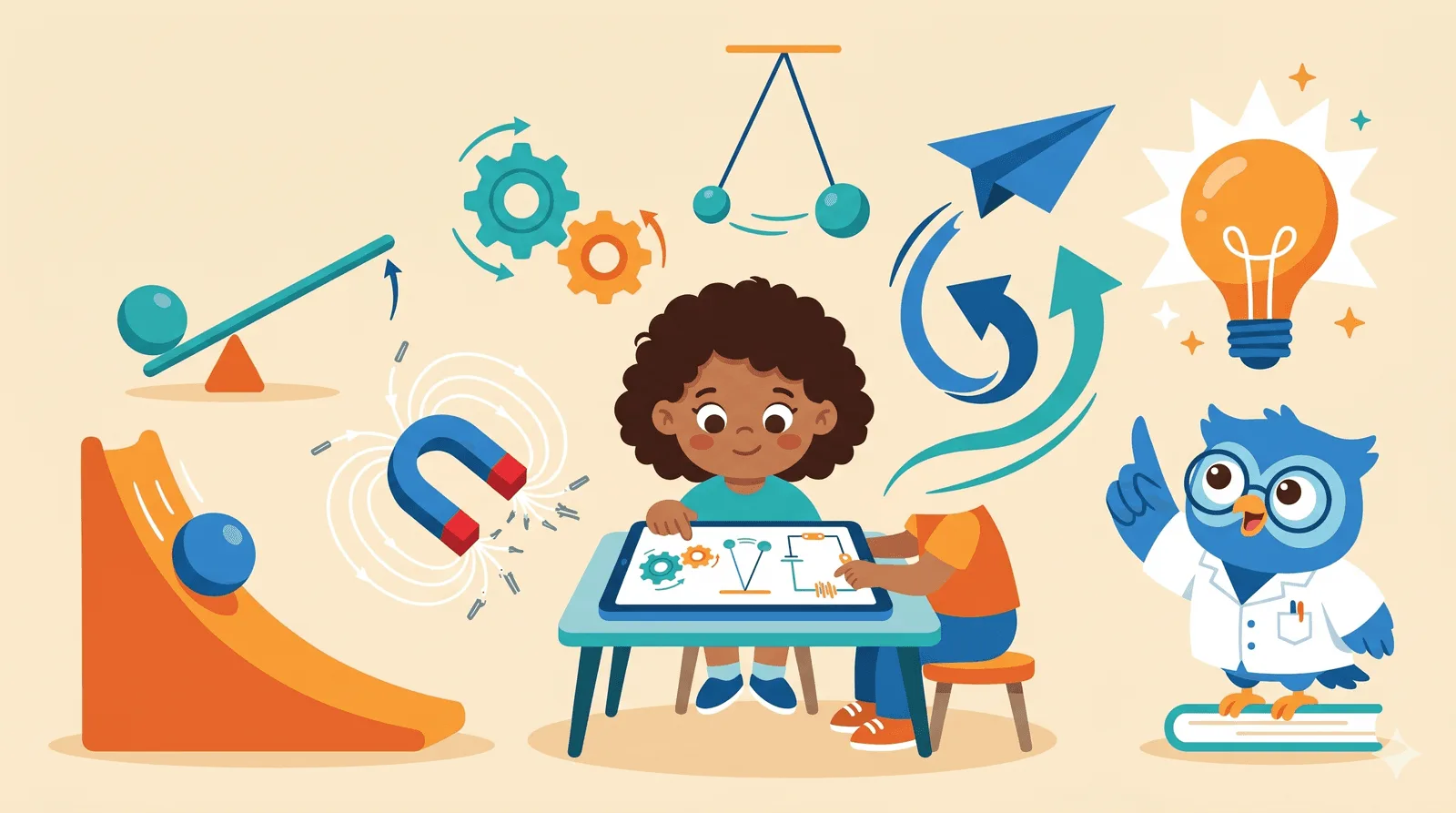
Ask a child why a ball rolls downhill, why a seesaw tips, or why their bike is hard to pedal uphill, and you have already started teaching physics. Physics is simply the study of the everyday world — how things move, push, fall and balance. Long before any equation, kids are natural physicists, testing the world with their hands.
The trick is to keep it that way. Children learn physics best not from formulas but from doing, predicting and being surprised. This guide walks through why physics is so good for young minds, the big kid-friendly ideas, and how to explore them at home with nothing more than the objects already around you.
Why physics is great for kids
Physics explains the world a child actually lives in. Why does a dropped cup fall but a balloon float? Why does a heavy box slide more easily on a smooth floor? Why does a tall tower of blocks topple over? These aren't abstract puzzles — they are the questions kids ask every single day. Physics gives them real answers, and that turns curiosity into understanding.
More than any single fact, physics builds cause-and-effect intuition: the deep sense that actions have predictable results. A child who learns to predict what will happen when they push, drop or balance something is building the foundation of scientific thinking. And it is best learned hands-on. A formula memorised is quickly forgotten; a tower that crashed because the base was too narrow is remembered for years.
The big kid-friendly physics ideas
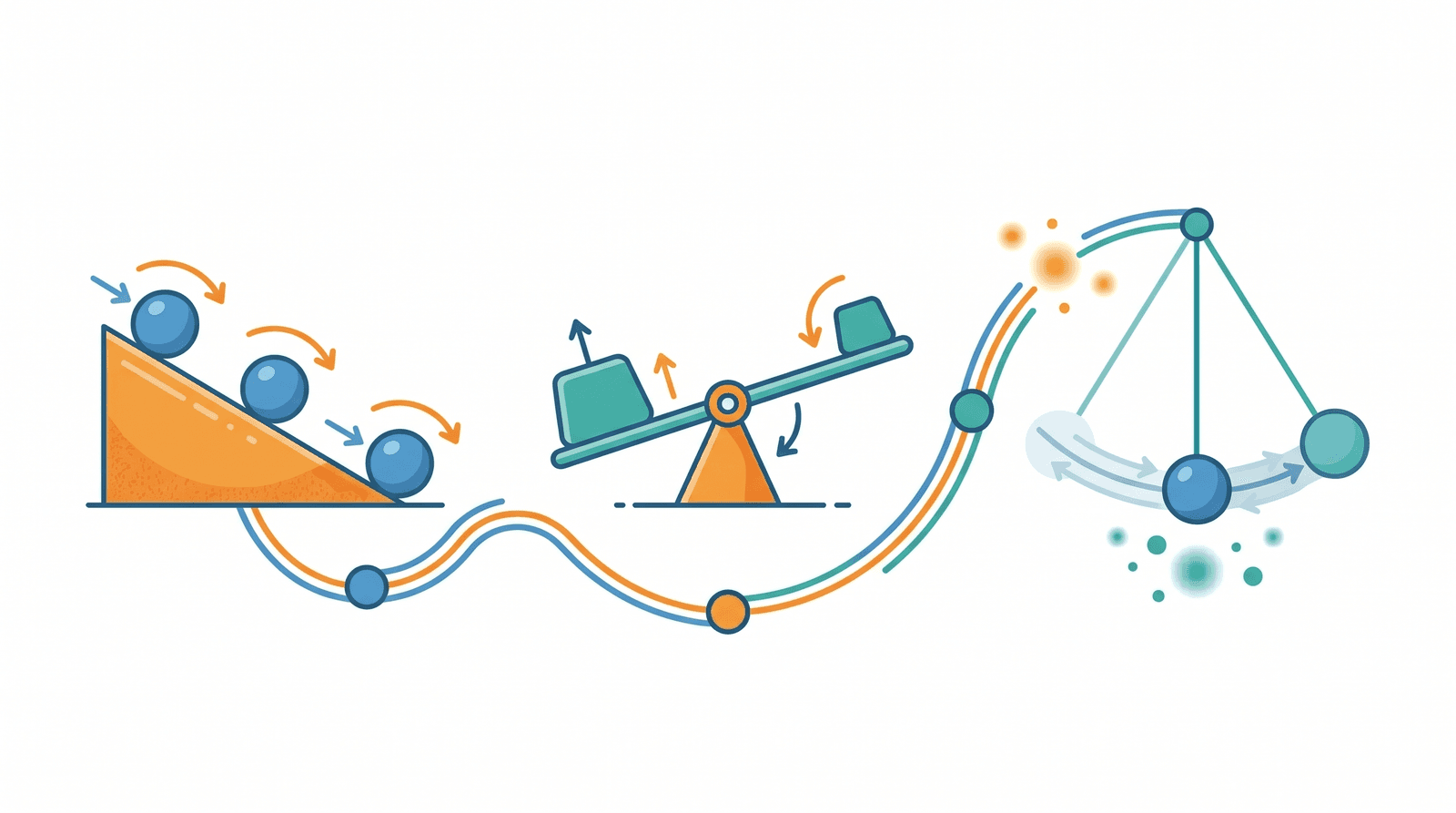
Three ideas carry almost all of childhood physics. First, forces and motion: every push and pull changes how things move. Gravity pulls everything down, friction slows things as they slide or roll, and a harder push makes things go faster or farther. Kids feel these forces in their own bodies — kicking a ball, sliding down a slide, dragging a toy across the carpet.
Second, energy: the ability to make things happen. Energy can be moving (a rolling ball, a swinging swing), stored (a stretched rubber band, a raised weight ready to drop), or carried as light and sound. Third, simple machines: clever tools that make work easier — the lever (a seesaw or bottle opener), the ramp, the wheel, the pulley, and the gear. Spotting these five machines in everyday life is one of the most satisfying games in all of physics.
How to explore physics with kids
Start with playful experiments using everyday objects. Race toy cars down ramps of different steepness. Build the tallest tower that won't fall. Float and sink things in the bath. See which surfaces let a marble roll furthest. None of this needs a lab — your kitchen and garden are full of physics.
The single most powerful technique is predict-then-test. Before any experiment, ask your child what they think will happen and why. Then try it. The gap between their guess and the result is where real learning lives. Keep asking "what happens if..." — what if the ramp is steeper, what if the ball is heavier, what if we add another wheel? Keep it concrete, keep it hands-on, and let surprise do the teaching.
How Samio teaches physics
Samio Learning's Physics Lab lets children discover forces, energy and simple machines through playful experiments that make big ideas click. Instead of formulas, kids predict, test and explore — tipping levers, rolling balls down ramps, storing and releasing energy — and see the science happen in front of them. Designed for ages 9 and up, the Physics Lab is adaptive, so it meets each child at the right level, and voice-supported, so kids can learn even before they read fluently. It's one module in the broader Samio curriculum that spans science, maths, reading and more. Free on iPad and Android, available in 7 languages.
Frequently asked questions
Isn't physics too hard for kids?
Not the way kids actually learn it. Physics only feels hard when it starts with equations. When it starts with rolling balls, balancing seesaws and falling towers, it's intuitive — children are doing physics from the moment they play. The hard symbols come much later; the ideas can start now.
What age can kids start physics?
Informally, from toddlerhood — every time a child drops, stacks or pushes something they're exploring physics. Structured, named concepts like forces and energy land well from around age 6, and richer ideas like simple machines and stored energy work beautifully from 8 or 9. Samio's Physics Lab is designed for ages 9 and up.
How do I teach physics at home?
Use everyday objects and the predict-then-test method. Ask what your child thinks will happen, try it, then talk about why. Race cars down ramps, build towers, float things in water, spot levers and wheels around the house. Keep it concrete and hands-on — you don't need any special equipment or a physics background yourself.
Do they need math first?
No. The core ideas of physics — forces, energy, motion, simple machines — can all be understood and explored with zero math. Children grasp them through observation and play long before they can calculate anything. Math becomes useful later for precise predictions, but it's never the starting point for kids.