Every parent of a young child knows the question. "Why is the sky blue?" "Where do clouds go?" "Why do leaves fall?" It can feel endless — but that stream of questions is the single most valuable thing your child does. It is science, in its purest form.
You don't need a lab, a degree, or a kit to raise a curious kid. You need to protect the curiosity that's already there, give it real things to explore, and resist the urge to hand over every answer too fast. This is the honest guide to sparking science early.
Why early science matters
Young children are natural scientists. Before they can read, they are already observing, predicting, testing, and revising. A toddler dropping a spoon from a high chair — again and again — is running an experiment on gravity. The instinct to ask "why" and "what if" is hardwired, and the early years are when it's strongest.
Early science isn't about memorising facts. It's about building habits of mind: noticing carefully, asking good questions, guessing what might happen, and checking. Children who keep these habits alive grow into adults who think critically — and the research is clear that curiosity in the early years predicts later engagement with learning far more than early test scores do.
Age-appropriate science topics
For primary-age children, the best science is concrete, visible, and tied to the world they can touch. Living things — plants, bugs, pets, their own bodies — are endlessly fascinating because they move, grow, and change. The weather happens every day right outside the window. Materials (water, ice, sand, wood, metal) behave in ways kids can see and feel. Even space, abstract as it is, captures imaginations through the moon, the sun, and the stars they can point at.
Keep it hands-on, not abstract. A 7-year-old doesn't need the chemistry of evaporation; they need to leave a saucer of water on the windowsill and watch it disappear over a week. Don't explain photosynthesis; plant a bean in a jar and watch the root grow. Concrete first, vocabulary later. The understanding has to be built from real things the child has seen with their own eyes.
How to nurture a young scientist
The most powerful thing you can do is encourage questions — and resist answering all of them instantly. When your child asks "why do birds fly south?", try "I wonder why... what do you think?" before reaching for the answer. Turning a question back into a shared investigation teaches them that figuring things out is something they can do, not just something adults already know.
Connect science to everyday life. Cooking is chemistry. A walk is biology and geology. A rainy day is meteorology. Do simple experiments — float and sink, mixing colours, growing seeds, shadows through the day. The goal is never the "right" answer; it's the loop of wondering, trying, and noticing. Praise the question as much as the conclusion, and never make a wrong guess feel like a failure.
How Samio sparks scientific curiosity
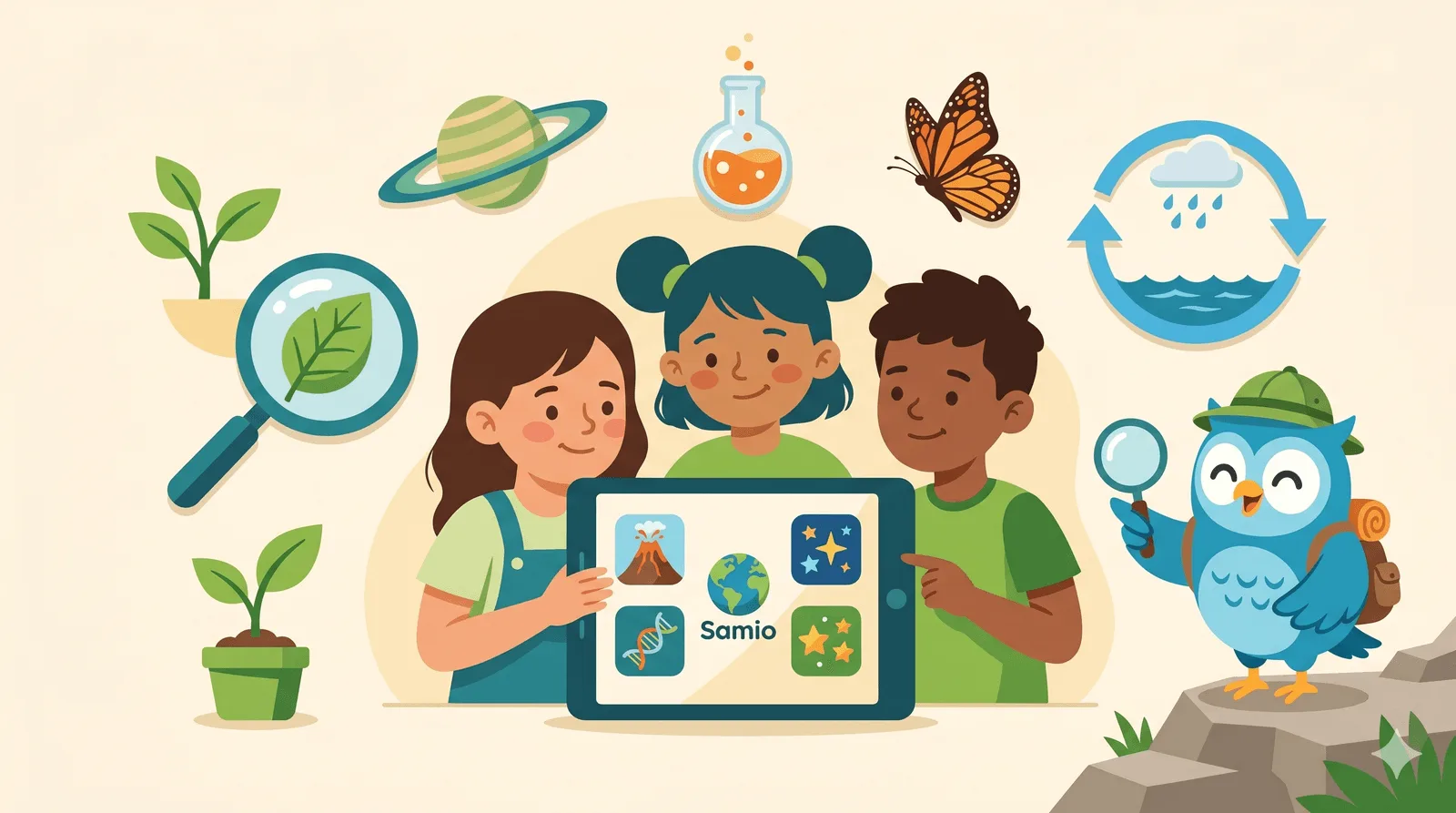
Samio Learning's Science Adventures module helps children explore the natural world through age-appropriate science topics and hands-on questions — living things, the body, weather, space, and materials. Designed for ages 8 and up, it adapts to each child's level so the questions stay challenging without becoming frustrating, and it's voice-supported so children can engage before they're fluent readers. Science Adventures is part of the broader Samio curriculum that also covers reading, maths, and more. Free on iPad and Android, available in 7 languages.
Frequently asked questions
What age should kids start science?
From birth, really — though not as a school subject. Babies and toddlers do science by exploring with their senses. Structured, topic-based science fits well from around age 5 or 6, when children can observe, predict, and talk about what happened. But the curiosity comes first; the labels come later.
How do I teach science without a lab?
You already have a lab — it's your kitchen, garden, and the walk to school. The best early science uses water, ice, food, plants, shadows, and weather. No equipment needed beyond what's in the house. The skill that matters is asking questions and observing carefully, and that costs nothing.
Is screen-based science any good?
It can be excellent for the parts that are hard to do at home — animations of how the body works, the planets, the seasons — and for adaptive questioning that meets a child at their level. The key is that it sparks curiosity and prompts real-world exploration, rather than replacing it. Screens and saucers of water work best together.
What topics are age-appropriate?
For primary-age children: living things (plants, animals, the human body), the weather, materials (water, ice, sand, wood), and space (sun, moon, stars). Keep it concrete and observable. Save the abstract stuff — atoms, energy, deep chemistry — for later, once the foundation of careful observation is solid.