

Generative AI in education has a credibility problem. Ask a general-purpose chatbot to write a 5th-grade lesson on photosynthesis and you'll get a confident, well-structured answer. About 80% of it will be correct. The other 20% will be subtly wrong — invented dates, mislabelled diagrams, fabricated sources, or curriculum standards that don't exist in your country. In casual writing, that's annoying. In a classroom, it's genuinely dangerous.
The technical name for this is hallucination, and it's the single biggest blocker to trustworthy AI in education. The best defence isn't a smarter model — it's grounding the model in verified knowledge. This article explains how knowledge bases, retrieval-augmented generation (RAG), and curated fact libraries actually reduce hallucination, why they matter for schools, and how Samio's Smart Engine implements them.
What is an AI hallucination?
In natural language generation research, a hallucination is generated content that is nonsensical or unfaithful to the provided source content (Ji et al., "Survey of Hallucination in Natural Language Generation", ACM Computing Surveys, 2023). Researchers distinguish two types: intrinsic hallucinations, where output contradicts the input, and extrinsic hallucinations, where output fabricates information not present in the input but presented as fact.
Large language models hallucinate because their training objective is next-token prediction, not factual correctness. When the model encounters a question whose answer wasn't well-represented in training, it produces something plausible-sounding that fits the pattern of similar text it has seen. The output is fluent because fluency is what was optimised; truth was not.
- Inventing a citation — a real-looking paper title, real-sounding authors, a real-looking journal, but the paper does not exist.
- Fabricating a curriculum standard — "Common Core 5.MD.7" (which doesn't exist) cited as the basis for a lesson.
- Misattributing a quote — pairing a famous person with a sentence they never said.
- Confabulating a historical date — a battle dated to a year that doesn't match any record.
- Generating wrong but confident math — a step in a derivation that flips a sign with no warning.
Why hallucination is worse in education
A hallucinated movie recommendation wastes ten seconds. A hallucinated curriculum standard wastes a week of teaching. The blast radius of an AI error in education is uniquely large because (1) the recipient is a child who lacks the prior knowledge to detect the error, (2) the error is reinforced through repetition and assessment, and (3) it propagates through homework, parent communication, and downstream lessons.
Teachers compound the problem when they trust AI tools the way they would trust a textbook. Textbooks are reviewed by editors, aligned to curricula by ministries, and corrected over editions. Generic LLM output has none of those guarantees. The literature on this risk is now substantial — see Chiu, Xia & Chai (2023), "Systematic literature review on opportunities, challenges, and future research recommendations of artificial intelligence in education", Computers and Education: Artificial Intelligence.
Grounding — the formal solution to hallucination
Grounding in NLP means tying an AI's output to verifiable, external sources. The grounded model doesn't have to know the answer in its weights — it has to retrieve and faithfully reproduce content from a trusted corpus. That shifts the trust boundary: instead of trusting a 70-billion-parameter blob, you trust a curated knowledge base that you can audit and update.
The most influential framework for this is Retrieval-Augmented Generation (RAG), introduced in Lewis et al., "Retrieval-Augmented Generation for Knowledge-Intensive NLP Tasks" (NeurIPS 2020). RAG works in two stages: a retriever pulls relevant passages from a vector index of trusted documents, and a generator conditions its output on those retrieved passages. The retrieval step grounds the model in verifiable text; the generation step adapts it to the user's request.
Recent surveys (Gao et al., "Retrieval-Augmented Generation for Large Language Models: A Survey", 2024) show that RAG-based systems reduce factual hallucination by 30–60% on QA benchmarks compared with prompted-only LLMs of the same size. The improvement is largest for domains where ground truth is structured and finite — exactly the structure of curriculum standards.
The grounding toolkit — RAG, knowledge bases, and constrained generation
Grounding is an umbrella for several complementary techniques. Each addresses a different failure mode.
Knowledge bases (KBs)
Structured stores of verified facts — entities, relationships, attributes — typically curated by humans and updated on a schedule.
Wikidata, Wikipedia, national curriculum standards databases. Samio maintains its own KB of curriculum standards by country, grade, and subject.
Retrieval-Augmented Generation (RAG)
Retrieve relevant passages from a vector index of trusted text, then generate output conditioned on those passages.
Used by Bing Chat, Perplexity, and most production AI assistants. Reduces extrinsic hallucination by ensuring the model cites grounded source material.
Fact libraries / templated content
Pre-vetted exercise templates, sentence banks, and answer keys that the AI fills in or selects from rather than inventing from scratch.
Samio uses fact-library-driven generation for math word problems, phonics, and reading comprehension where answer keys must be deterministic.
Constrained generation
Restrict the model's output to a defined schema, vocabulary, or grammar, eliminating whole classes of error.
JSON-mode generation, regex-constrained decoding, finite-state output. Used in Samio's exercise generation to prevent malformed outputs.
Verification layers
Post-generation checks that compare AI output against a source of truth and reject or flag mismatches.
Samio cross-checks generated curriculum citations against the standards database; mismatches are rejected before reaching the teacher.
How Samio grounds its Smart Engine
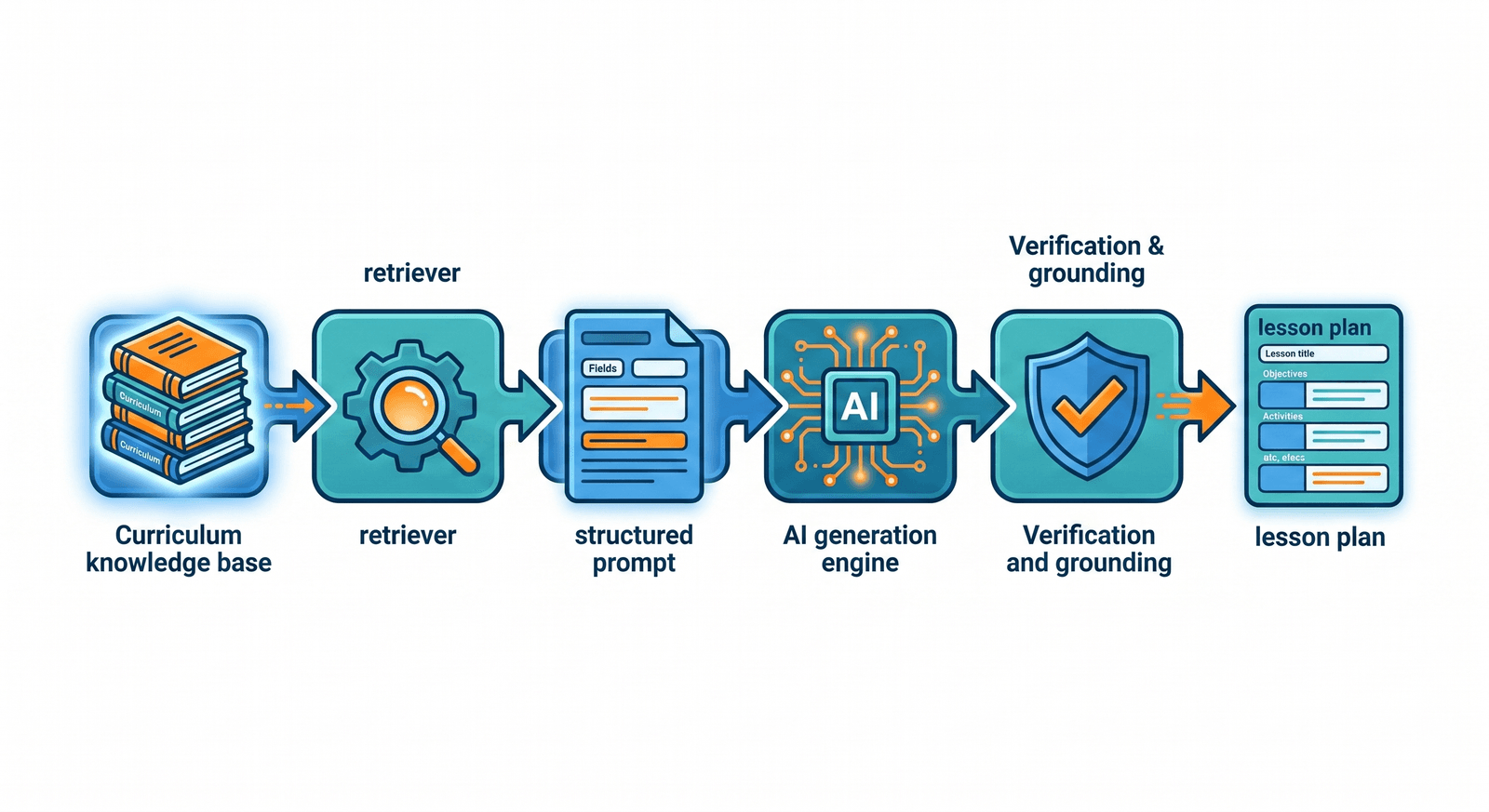
Samio's Smart Engine — the AI system behind year plans, lesson units, custom challenges, and exercise generation — uses all four grounding techniques above. The architecture is deliberately conservative: the AI never authors curriculum on its own.
Here's what happens when a teacher asks Samio to generate a year plan for "5th grade mathematics, Netherlands":
- Curriculum retrieval — Samio's database of national curriculum standards (per country, grade, and subject) is queried first. The standards for "NL, grade 5, mathematics" are retrieved as structured records, not free-text the model has to interpret.
- Prompt grounding — those structured standards are injected into the AI prompt as the source of truth. The AI's job is to organise and adapt them into a year plan, not to invent which standards exist.
- Schema-constrained output — the year plan is generated against a fixed schema (week, theme, unit, exercise types). The model cannot output fields outside the schema, eliminating structural drift.
- Fact-library exercises — for the actual exercises, Samio draws from pre-vetted templates and word banks aligned to each standard. Hallucination-prone parts (rote facts, vocabulary lists, math answer keys) are deterministic; the AI handles only framing.
- Verification layer — every generated plan is checked against the standards database. Any standard cited that isn't in the source-of-truth database triggers a regeneration or flag for review.
- Per-country specialisation — the engine carries separate KBs for each supported country, so a "grade 5" plan in Spain reflects LOMLOE, not Common Core.
How this compares to other AI tools in education
Many AI-in-education tools share a surface similarity ("we generate lesson plans!") but differ enormously in how grounded their output is. Here's an honest comparison.
| Feature | Samio | ChatGPT | Khanmigo | MagicSchool |
|---|---|---|---|---|
| Curriculum-aware grounding | KB of national standards per country | None — relies on training data | Khan Academy curriculum (US-centric) | Templates + LLM, partial grounding |
| Per-country curriculum support | Full — multiple national curricula | Implicit (training corpus) | Limited (Khan content) | Limited (US standards) |
| Hallucination mitigation | RAG + fact library + verification | Plain LLM (high hallucination) | RAG over Khan content | Templates + light grounding |
| Citation of source standards | Yes — cited per unit | Often hallucinated | Yes (Khan-only) | Sometimes |
| Output schema enforcement | Strict (year plan, lesson, exercise schemas) | None | Conversational | Template-driven |
| Languages | 7 (curriculum + UI) | Many (without curriculum grounding) | English (some Spanish) | English-first |
| Suitable for primary curriculum compliance | Yes | No (requires verification) | Partial | Partial |
The takeaway: "AI for education" is not a single category. A grounded system with a curriculum knowledge base produces a fundamentally different artefact from a prompted general LLM, even if the surface UX looks similar.
Honest limits — grounding doesn't make AI infallible
We don't claim Samio is hallucination-free. Grounding reduces hallucination dramatically, but two failure modes remain: (1) the underlying knowledge base can be incomplete or out of date, and (2) the model can still misuse correctly-retrieved content (for example, applying a 4th-grade standard to a 6th-grade plan).
We mitigate this by (a) versioning the curriculum KB and tying every output to a specific KB version, so we can roll back; (b) shipping a teacher-in-the-loop review step before any AI output is published to students; (c) logging every generation event to support post-hoc audit; (d) running an internal evaluation suite that re-tests the engine against a frozen set of expected outputs whenever the KB or model is updated. The goal isn't perfect AI — it's AI that fails safely and visibly.
Why this matters for schools
For school administrators, the practical implication is simple: when you evaluate an AI-in-education tool, ask three questions. (1) Where does the curriculum knowledge come from? (2) What happens when the model is asked something outside its grounded knowledge base? (3) Can the system cite, version, and audit its outputs?
- Curriculum compliance — generated plans cite real, current standards from your country's education authority, not invented ones.
- Auditable AI — every generation references the KB version it used, making post-hoc review possible.
- Teacher control — the human-in-the-loop review step is a feature, not a workaround.
- Cross-country support — the same engine respects local curricula instead of applying a US-shaped lens everywhere.
- Less remediation work — fewer fabricated facts in classroom material means less teacher cleanup.
- Defensibility under inspection — when a regulator or parent asks "where did this come from?", there's an answer.
Knowledge first, AI second
Generative AI is not the protagonist of educational technology. The curriculum is. The science of how children learn is. The teacher is. AI is a powerful tool for organising and adapting that knowledge, but it can't be the source of it.
Samio's bet is that the EdTech tools that survive the hype cycle will be the ones that put knowledge first and treat AI as the disciplined assistant it should be. We're building accordingly.
FAQ
What is an AI hallucination?
A hallucination is AI-generated content that is unfaithful to its source — either contradicting verified information (intrinsic) or inventing facts not present in any source (extrinsic). The output is fluent and confident, but factually wrong.
What is RAG, and how does it reduce hallucinations?
Retrieval-Augmented Generation (RAG) is a technique where the AI first retrieves relevant passages from a trusted document store and then generates output conditioned on those passages. By grounding generation in verifiable text, RAG reduces extrinsic hallucination by 30–60% compared with prompted-only LLMs (Gao et al., 2024).
How does Samio prevent hallucinated curriculum standards?
Samio retrieves official national curriculum standards from its own database before any AI generation, injects them as structured records into the prompt, and verifies all cited standards against the source-of-truth database after generation. Standards that don't exist in the KB cannot appear in output.
Is grounded AI the same as just "ChatGPT for schools"?
No. A general LLM relies on whatever was in its training corpus and produces confident output even when it has no factual basis. A grounded system retrieves from an authoritative knowledge base, constrains output to verified content, and rejects citations that aren't in the KB.
Can grounding eliminate AI hallucinations entirely?
No, but it reduces them substantially and makes the remaining errors visible and recoverable. Samio combines RAG, fact libraries, schema constraints, and verification layers, plus a teacher-in-the-loop review step before any output reaches students.