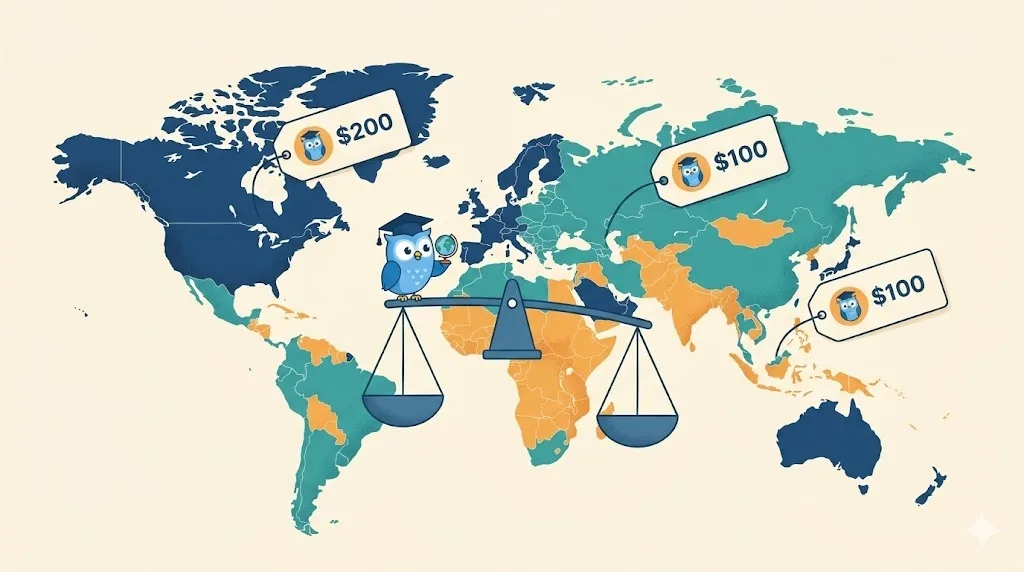
Education technology has a quiet contradiction at its heart. Tools designed to expand access are usually priced for the markets that need them least. A $19 monthly subscription is a coffee in San Francisco and three days of a teacher's wages in Lagos. The product is the same; the burden is not.
At Samio Learning, we decided to do something different. Our pricing follows World Bank country income tiers, with discounts of up to 75% for schools in lower-income economies. This article explains why we built equity pricing, the economic foundation behind it, how the tiers work, and how the model compares with the rest of the EdTech industry.
What is equity pricing?
Equity pricing — also called purchasing-power-parity (PPP) pricing or income-indexed pricing — adjusts the cost of a product to the economic context of the buyer. The product is identical for everyone; only the price differs. The aim isn't charity. It's recognizing that a flat global price is itself an arbitrary choice — one that happens to favor wealthy markets.
The idea isn't new. The Big Mac Index, published by The Economist since 1986, demonstrates how the same product carries vastly different real prices across economies. International publishers, software vendors (Adobe, JetBrains, GitHub Education), and streaming services (Netflix, Spotify) all use some form of regional pricing. What's relatively new is applying this rigorously to school software.
Equity pricing is distinct from charity-style 'free for the poor' models. The school still pays — they pay an amount that reflects their economic context. This preserves dignity, predictability, and the commercial discipline that keeps a product sustainable.
The problem with flat global pricing
Most EdTech is priced in US dollars at US-market rates. The result is consistent across categories: a tool that costs 0.5% of a teacher's monthly salary in Sweden costs more than 30% of a teacher's monthly salary in Bangladesh. Studies of EdTech adoption in lower-income countries repeatedly show that price is the dominant barrier — outranking infrastructure, training, and language.
It isn't only unfair. It's economically irrational for the vendor. A flat global price excludes the majority of the world's students from products designed to help them. UNESCO estimates that 244 million children are out of school globally, with the highest concentrations in regions where flat-priced EdTech is structurally unaffordable.
- Roughly 60% of school-age children in low-income countries lack access to basic literacy tools (UNESCO, 2023).
- GNI per capita in lower-middle-income economies is approximately one-thirtieth of that in high-income economies (World Bank Atlas method).
- EdTech adoption in sub-Saharan Africa is 5–8× lower than in OECD countries despite higher demand for foundational skills (UNICEF / Global Education Monitoring Report).
- When PPP-indexed pricing is applied, willingness to pay in middle-income markets typically rises 3–4× while preserving margin (Harvard Business Review research on software pricing).
The economics behind it — Atlas method, GNI, and PPP
Equity pricing isn't arbitrary. It's anchored in measurable economic indicators. The most widely accepted is the World Bank's Atlas method, which classifies every country into one of four income groups based on GNI (Gross National Income) per capita: high, upper-middle, lower-middle, and low. The thresholds are reviewed annually and published openly.
A complementary measure is purchasing power parity (PPP), maintained by the OECD and IMF. PPP adjusts for what a unit of currency actually buys locally — accounting for differences in food, housing, transport, and services. PPP-adjusted incomes show that nominal exchange-rate comparisons systematically overstate the real wealth gap, especially between high and lower-middle-income countries.
Samio uses World Bank income tiers as the primary anchor because they are: (1) updated annually by an independent institution, (2) the source-of-truth for international development organisations, (3) resistant to short-term currency volatility, and (4) widely understood. The result is a pricing structure that follows economic reality, not marketing intuition.
How Samio's three tiers work
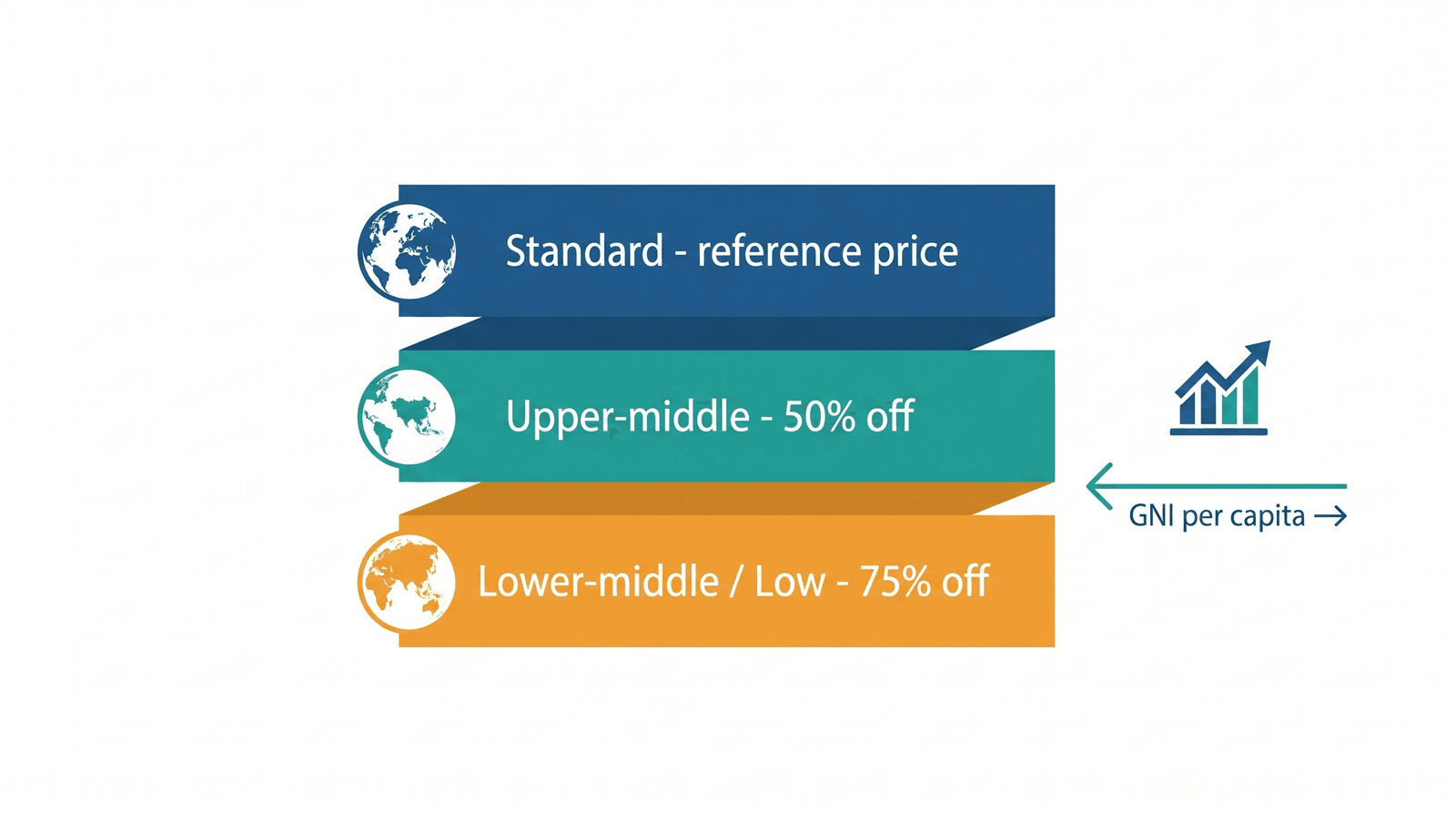
Samio collapses the World Bank's four income groups into three pricing tiers. The school's billing country determines the tier, and the tier is locked at registration to prevent gaming.
| Tier | Discount | GNI per capita | Examples |
|---|---|---|---|
| Standard (Tier A) | Reference price | GNI per capita above the World Bank high-income threshold | United States, United Kingdom, Germany, France, Netherlands, Canada, Australia, Japan, South Korea. |
| Upper-middle income (Tier B) | ≈ 50% discount | GNI per capita in the upper-middle band | Mexico, Brazil, Argentina, Colombia, Poland, Romania, South Africa, China, Turkey, Malaysia. |
| Lower-middle / Low (Tier C) | ≈ 75% discount | GNI per capita in the lower-middle or low band | India, Indonesia, Philippines, Vietnam, Egypt, Morocco, Bolivia, Bangladesh, Pakistan, most of sub-Saharan Africa. |
How this compares to other EdTech pricing models
Several pricing strategies coexist in EdTech. Each makes a different tradeoff between fairness, simplicity, and revenue. Here's how the main approaches compare.
| Approach | Example | Tradeoff |
|---|---|---|
| Flat global pricing | Most US-based SaaS EdTech (default model) | Simplest to operate; structurally excludes most non-OECD markets. |
| Free for everyone | Khan Academy, Duolingo (free tier) | Maximum reach; relies on philanthropy or ads, limits product depth and child-safety guarantees. |
| Freemium + regional discounts | Some Adobe and Microsoft education plans | Better access; gating discounts behind enterprise paperwork excludes small schools. |
| Per-country negotiated pricing | Pearson, McGraw-Hill (textbooks) | Captures local price sensitivity; opaque, unfair to small buyers, prone to arbitrage. |
| Income-tier pricing (Samio) | Samio Learning, JetBrains, some indie SaaS | Transparent, formula-based, accessible; requires verifiable billing address. |
The income-tier model is the only approach that combines transparency (anyone can read the rule), fairness (price follows local capacity to pay), and operational simplicity (one rule, applied at registration). It also preserves a commercial relationship — schools are customers, not aid recipients.
Implementation rules — how we keep it honest
Equity pricing only works if the rules are clear and resistant to abuse. Samio's implementation has four guardrails:
- Tier resolved from billing address at registration. Schools enter the country of the institution they administer; that country maps to a tier via the published World Bank table.
- Tier locked at registration. Schools cannot move to a cheaper tier later by changing their billing country. This prevents companies in high-income countries from gaming the system.
- Manual review for verified hardship. NGO partners, regional networks, and individual schools with documented economic need can apply for additional adjustments outside the standard tiers.
- Public and formula-based — not discretionary. There is no negotiation, no sales rep, no enterprise upsell. The rule is published, applied uniformly, and updated when the World Bank publishes new income classifications.
Why this matters for kids
The students who benefit most from adaptive learning tools are often the ones least likely to have access to them. A child in rural Bolivia, a refugee student in Lebanon, a first-generation immigrant in a French banlieue — these are the learners for whom an adaptive app makes the largest difference, because they typically have the least access to one-on-one tutoring or differentiated instruction.
Pricing decisions are educational decisions. When a tool is priced at OECD rates everywhere, it becomes a luxury good in most of the world — a quiet signal that 'this learning is for somewhere else.' Equity pricing reverses that signal.
- Access — schools that would have been priced out can now adopt the same tool used in OECD countries.
- Dignity — students aren't beneficiaries of charity; their schools are paying customers like any other.
- Sustainability — Samio remains commercially viable across all markets, so the product can keep improving.
- Pedagogical equity — the same adaptive engine, content, analytics, and DPA terms are available regardless of geography.
- Network effects — wider adoption strengthens the comparative datasets that improve the platform for everyone.
Objections we've heard (and how we think about them)
Equity pricing isn't universally popular. Here are the most common objections we encounter, and how we respond.
Won't this lose you money?
No. Markets we couldn't reach at flat pricing become accessible — net new revenue. And in higher-income markets, nothing changes. The math works because most of our cost is fixed (engineering, content, infrastructure); marginal cost per student is near zero.
Couldn't a school in a high-income country abuse this by registering through a foreign branch?
We lock the tier to the billing address of the operating institution at registration, not a parent company. Audits happen if patterns are inconsistent, and unexplained mismatches result in tier reclassification.
Why not just be free everywhere, like Khan Academy?
Free products are sustained by donations, ads, or upsell to paid services. We chose paid + equity because it preserves product depth, eliminates ads (critical for child safety), and gives every school the same enterprise-grade contract — DPA, audit logs, GDPR, support — regardless of price tier.
Isn't this just regional pricing under a new name?
Regional pricing is opaque and discretionary; equity pricing is formula-based and public. Anyone can compute their own tier from public World Bank data. There's no negotiation and no enterprise upsell.
What if World Bank classifications change?
We follow the annual review. Schools already on a tier keep that tier — we don't claw back. New registrations use the latest classification. This is an explicit policy, not an oversight.
Pricing as a product feature
We've come to think of equity pricing as a product feature, not a marketing decision. It changes who can use Samio, which changes the data we see, which changes what we can build. A platform serving 100 OECD schools has fundamentally different signals than one serving 10,000 schools across 80 countries.
If you run a school in any country and the standard tier doesn't match your economic reality, contact us. The published tiers are the floor of access, not the ceiling.
Samio Schools — Equity Pricing →
FAQ
What is equity pricing for education?
Equity pricing is a model where the cost of an educational product varies by the buyer's economic context — typically based on World Bank country income tiers — while the product itself remains identical for everyone.
How does Samio determine which tier a school qualifies for?
Samio uses the school's billing country at registration. The country maps to a tier via the World Bank's annual income classification: Standard (high income), about 50% discount (upper-middle), or about 75% discount (lower-middle / low). The tier is locked at registration.
Can a school move to a cheaper tier later?
No. The tier is determined and locked at registration based on the billing country. Schools with a verified change in circumstances — a documented economic emergency or NGO partnership — can apply for manual review.
Does equity pricing affect the product or features?
No. Every Samio Schools tier — Standard, Upper-middle, Lower-middle/Low — receives the same product: same Smart Engine, same analytics, same LMS integrations, same DPA, same audit logging, same support SLA. Only the price differs.
How is equity pricing different from a free or freemium tier?
Free tiers are subsidised by ads, donations, or upsell to paid services. Equity pricing is paid — but at a level that fits the local economy. This preserves the commercial relationship, eliminates ads, and gives every school the same enterprise-grade contract.